
Files
Treatise on the existence of five dimensions; and on the consequences that would result from their full exploitation by Mankind
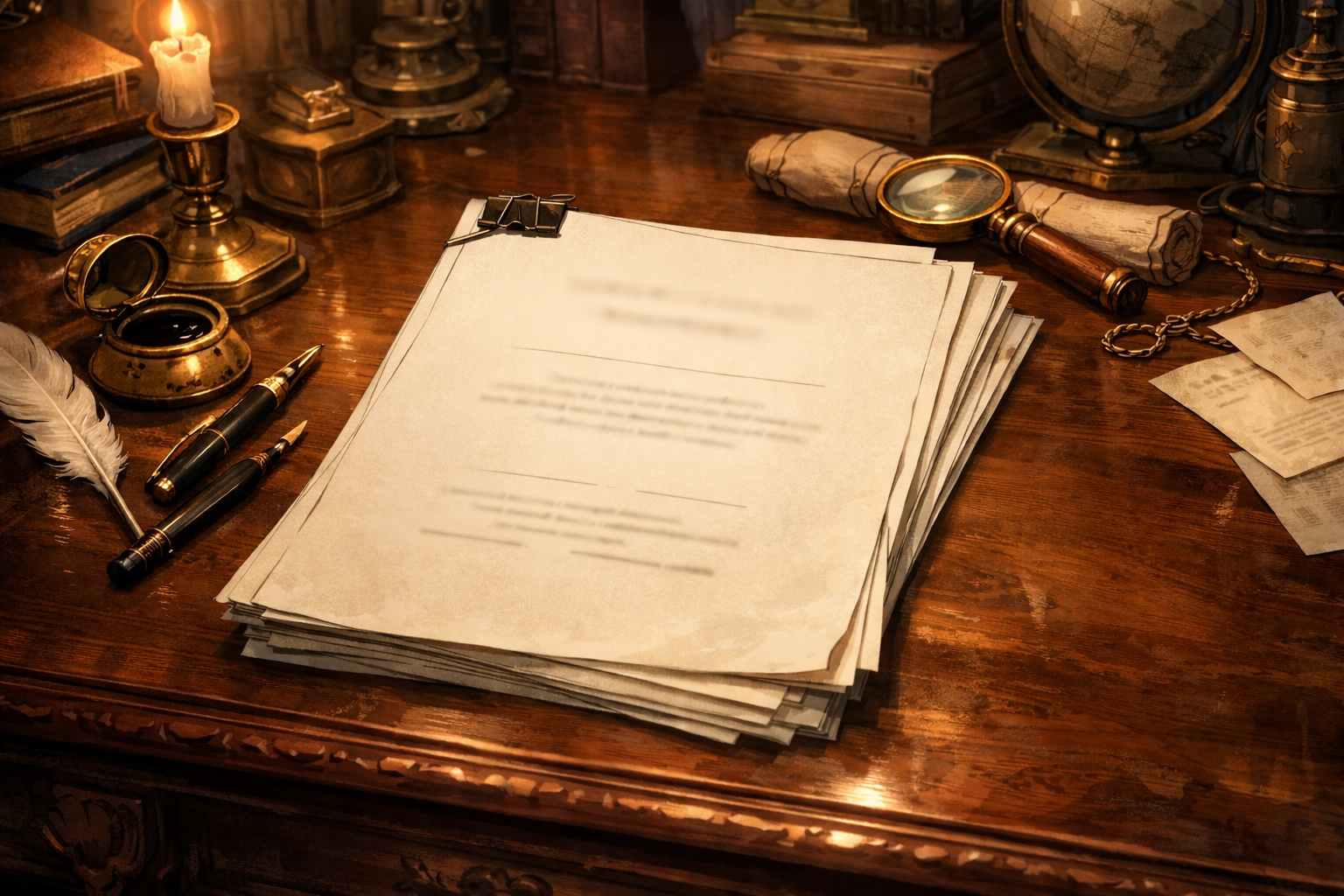
Written in Paris between 1840 and 1842 by an auditor not enrolled in the courses of the Faculty of Sciences of Paris, this treatise was never officially presented. We present it here without its appendices, which have not been found.
Introduction
We are, of course, familiar with the three dimensions that govern the physical order: length; width; depth. The object of this treatise is a theory that some might deem bold or even heretical, adding two additional dimensions. It is as a free thinker that I come to deliver the conclusions of my research, as well as concrete avenues of application to exploit the infinite resources offered by these two additional dimensions: Time, and Reality.
For theoretical purposes, and for any future calculation, we shall name length A; width B; depth C; time X; reality Y.
Time
The fourth dimension, Time, is tangible. Indeed, we move with it continuously. Time flows in only one direction, which seems impossible to control if we stick to modern science.
Yet time, like the three "main" dimensions, follows an axis. Thus, when mediocre essayists claim that equally mediocre fictional characters travel "through time" and find themselves halfway around the world, said essayists commit an elementary error in reasoning.
The problem with Time as a dimension is that, assuming it is possible to move freely within it, leaving for another era could engender fatal paradoxes. An informed time traveler should therefore, in my view, take all necessary precautions.
Many paradoxes can result from an ill-orchestrated time travel. A few paradoxes and their possible consequences are examined in Appendix A.
Reality
If we accept Time as a fourth dimension, and if we assume that it is possible to alter it, this is tantamount to saying that it is possible to create new Realities; that is to say, worlds where, someone having moved from a point A of the fourth dimension to a point B of the latter, one or more semantic shifts would have inevitably led to the advent of a new reality, if only by an event as insignificant as the disappearance of an insect, inadvertently crushed by our hypothetical time traveler.
One could go further and consider the existence of other universes far removed from our own. And these universes would be generated by fiction.
This is the theory of Reality as a dimension.
This theory probably has limits, but experiments are necessary to be able to verify it.
Ethics
In my opinion, it is paramount to respect the visited dimension (Era and/or Reality), and not to alter it more than necessary. Thus, with wars, downfalls, and decadence proceeding from the natural course of history, it seems futile to consider preventing such events.
Furthermore, on a human level, our ancestors did not speak the same language as we do. What will it be like for our descendants? It could prove complicated, if not impossible, to dialogue. Let us not speak of what would happen to the reckless traveler who found themselves in a country other than their own, unable to understand the local language if no instant translation technique exists in a given XY coordinate.
Practical Applications
In the current state of science, it does not seem possible to change eras or realities at will. Appendix B contains the design plans for the machine to which I give — quite immodestly, it is true — my name: the Émarne spatio-dimensional shifter. The materials used being of an extraordinary rarity, and the degree of mastery required to design such a machine so demanding, I have no doubt that no one will succeed in reproducing this device. Notwithstanding, I do not recommend it, insofar as it is a prototype machine that presents many risks on a human level, if only because it is currently impossible to configure the era or arrival location with precision.
Wishing not to cause useless losses, I intend to be my own guinea pig. I shall endeavor to arrive in the future, for I have no doubt that the available technologies and knowledge will allow me to complete this study.
The Oratrix
… Others do better work than I do.
The job of TV announcer is still very young, and my few female colleagues are enjoying a certain degree of success.
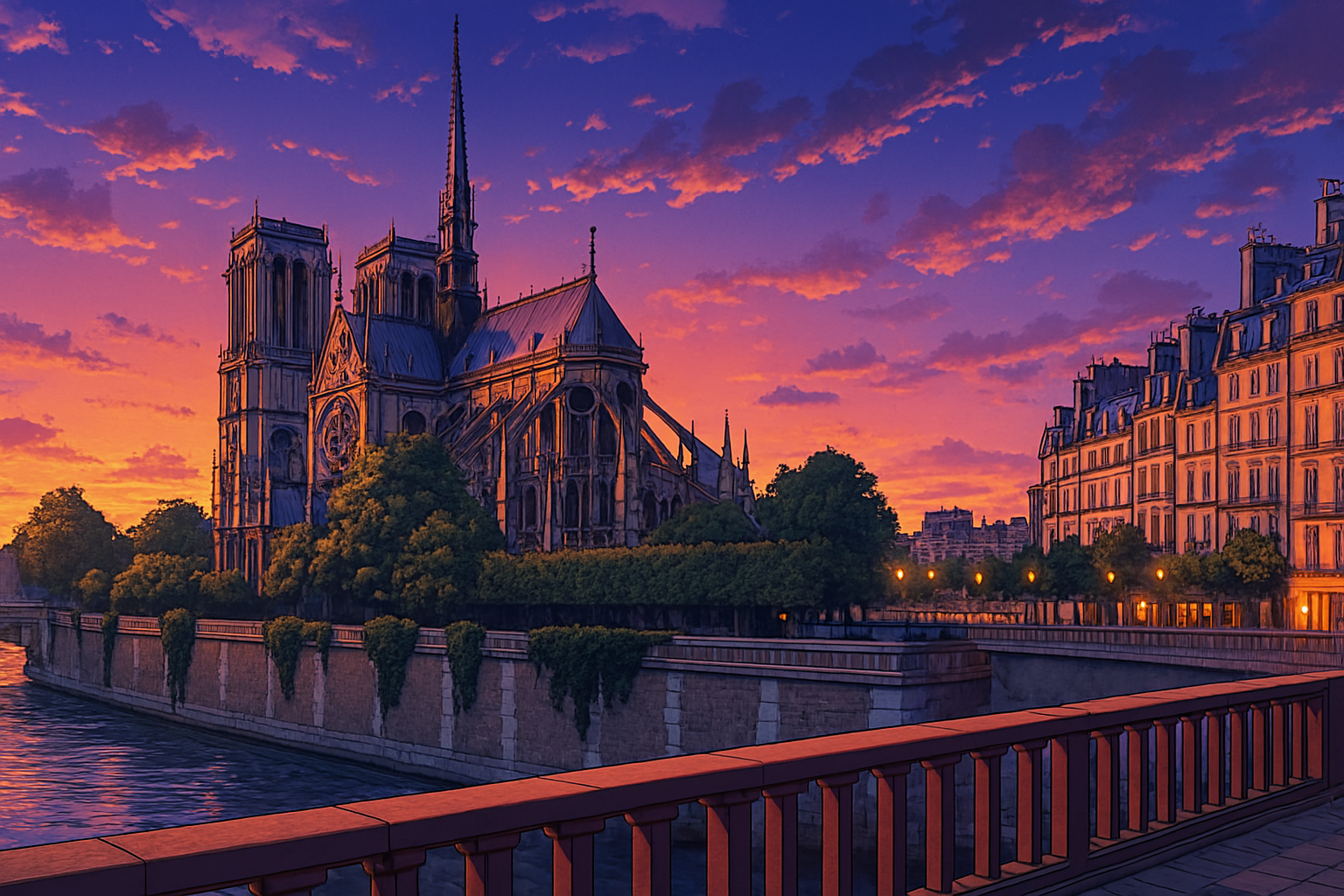
One melancholy evening, leaning on a bridge over the Seine, I was contemplating Notre-Dame. What a monument. What a structure. Like many of my contemporaries, I was a believer. The separation of Church and State had occurred only about fifty years earlier. Now, disappointed by my peers, I was considering cloistering myself in a convent. The profession turned out to be far more thankless than I had thought, and I suffered from an awful lack of recognition.
- Mam'selle O’Ceross !
At the sound of that familiar voice, I turned around. It was Pierre, an intern at the RTF, the only one I got along with even a little bit.
- Hello, Pierre. How are you ?
- The station director is looking everywhere for you ! It’s time for your segment !
- Ah. Of course.
Pierre brought me back to reality. But I no longer wanted to work for television. I no longer wanted to show myself to all of Paris — and soon, I knew, to other major cities in France.
I was hardly universally liked. Judging by the viewers' letters, I was too flighty a girl for such a job. Holy Mary, mother of God. Had I really sinned that much ?
- I'm not coming, Pierre.
- But… M’selle O’Ceross…
- Maybe I'm not cut out for this job after all, I said with a forced smile.
I turned my back on him and left him standing there. Leaving radio had been a mistake. I used to host a cooking show there. How could I have believed that becoming an announcer for the RTF news would do me any good ?
I would have to go back home to my parents in Étretat; explain to them that their daughter was nothing but a good-for-nothing. And then I'd end up in a convent. A nun faces hardly any surprises. One has an orderly life, and one answers only to God.
That's what I was telling myself, absent-mindedly turning on the television set in my apartment. Unsurprisingly, they had found a girl to replace me. Good.
I fell asleep with a heavy heart. And the next day, like every Sunday, I went to Notre-Dame for mass.
As I came out, I noticed a strange man. His outfit seemed to come from another era… it was daring. A short-sleeved jacket, a long-sleeved garment underneath, sunglasses, and a strange headset on his head. It looked like headphones; yet the headsets used on the radio or TV are much heavier.
- Catherine O’Ceross ?
As he spoke my name, he shot me a strange smile.
- That is indeed me. Whom do I have the honor of addressing ?
- Miss, I am here to make you an offer. An offer that will change your life forever.
Pentadimensional reflections
I feel a sudden urge to dive back into my youthful research from when, at twenty years of age, I was drafting what would become the foundation of my current work. That was back in 1842. People still called me Arsène Émarne then.
This text is not biographical. Just as I dislike monologues, I have no desire to talk about myself excessively — a stance that may, of course, seem paradoxical given the extraordinary task entrusted to me.
So, let us get to the point. Back then, I theorized the concepts of the fourth and fifth dimensions (Time and Reality, the anchors of all my research), before moving from theory to practice. That is how I ended up in another Reality, in another Time. And indeed, I succeeded beyond all expectation, waking up several centuries in the future.
Two topics, in fact, draw my attention today — two subjects that round out the concept of Reality as a fifth dimension. I was unable to grasp them back in the 1840s; now, with the benefit of additional wisdom, I believe I can offer some conclusions, which might prove useful to the Organization.
1. Planes of existence
My previous study touched upon the possibility that fiction could create Realities ex nihilo. This turned out to be true; and likewise, Realities create fictions. But certain works of fiction explore similar concepts. American authors revel in expanding "multiverses" without ever capturing the core essence of the concept. It takes a European, it seems to me, to possess an artistic enough sensibility to grasp what is truly at play, compared to the American, whose logic remains largely commercial. And I know full well that Americans will read this, but you see, I take the freedom of speech guaranteed by the First Amendment of your Constitution at face value, and I say to you: you are shopkeepers. It is no big deal. It is merely a modest observation.
But let us look at concrete examples, drawn from Japanese fiction instead, as the concept of a plane of existence seems far better understood by Kotaro Uchikoshi's people than by Robert Zemeckis's.
In the video game The World Ends With You, the deceased protagonists find themselves in an alternate Shibuya overlaying the world of the living. In the Digimon franchise, the Digital Worlds are digital realms inhabited by creatures known as Digimon, and most protagonists can travel more or less freely between their real world and the Digital World.
Likewise, to take an example closer to France, the comic series Philémon by Fred features a young man brought, through various supernatural pathways, to travel between our very real world and that of the Letters of the Atlantic Ocean — where said letters are inhabited landmasses resting upon the sea.
Are these Realities? Sub-Realities?
The answer is no.
Shibuya's UnderGround, the Digital Worlds, the Letters of the Atlantic Ocean — each of these three spaces belongs to its own respective Reality. A young man who dies in a Shibuya existing in the world of the Letters of the Atlantic Ocean will not end up in the UnderGround, unless the UnderGround exists in that specific world. By the same token, no Tokyoite capable of reaching the UnderGround should ever be able to set foot on the Letters.
The case of Digimon is intriguing, given that several Realities feature these creatures. Thus, the stories told in Digimon Adventure and Digimon Tamers do not unfold within the same Reality.
Similarly, the American shopkeepers mentioned earlier are hardly stingy when it comes to alternate Realities.
Regarding time travel, alterations made to the continuum generally spawn new Realities. However, the fluid rules governing temporal travel seem to vary from one Reality to another. This can be further compounded by cultural factors. Where Westerners deploy machinery, Asians will often summon paranormal explanations — frequently tied to death — to account for time travel. Since the very nature of the movement differs, it comes as no surprise that the rules governing it differ as well.
This strikes me as a good entry point to address my second topic.
2. Concerning death
Research conducted throughout the 22nd century will uncover the final, irrefutable truth about the afterlife. We have every reason to believe that the afterlife is a concept of extraordinary complexity, and that upon death, an individual will find themselves in whichever afterlife they believed in.
It follows that — with the exception of afterlives taking place directly on Earth (typically reincarnation, which, incidentally, can occur in a Reality other than the one from which the reincarnated individual originates, as illustrated by the fact that upon his passing, singer Koji Wada reincarnated as a butterfly in a reality where Digimon exist) — each afterlife possesses its own plane of existence. The Greek Underworld, the Christian Hell, and Valhalla are therefore all autonomous spaces in which the deceased may end up if they sincerely believe in them.
The Organization counts a ghost among its employees. It is an intriguing case. A ghost is generally not in an afterlife state. In truth, a ghost is an imprint of who the person was at the exact moment of their death. Ghosts exist only to the extent that the being who brought them forth still had unfinished business while alive. Thus, as long as that business remains undone, the individual, in their ectoplasmic form, cannot find rest. The generation of an ectoplasm has nothing to do with a person's beliefs. Trapped in our world, should the spectre ever depart after finding the rest it sought, it will then move on to the afterlife in which it believed.
Of course, if you believe there is nothing after death, there will be nothing. I strongly encourage you to reconsider the matter as soon as possible, for your own good.
Although ectoplasmic existence is not an afterlife, ghosts also exist due to beliefs — though here, it seems more closely linked to societal beliefs than to individual ones. The environment creates the opportunity. You stand a much higher chance of leaving an ectoplasmic imprint if you are Scottish than if you are Maltese.
There you have it. These modest reflections certainly cannot replace a more comprehensive study, but I believe they serve as a fine addition to the treatise I wrote several centuries ago.