The case of the missing instrument
Prologue
The detective bolted upright, wide awake. The same nightmare, again. He’d been hunting for missing VIPs, only for the world around him to warp into a zoo, then an amusement park. And he had failed.
Éric Antony wiped the sweat from his brow. A nagging feeling told him this was more than just a dream — like something had actually happened to him. Yet here he was, sitting in his office at Promenade-les-Pins. The suffocating heat of a brutal early summer wasn't doing his racing thoughts any favors.
The door swung open. Enter Matthias, his assistant.
“Got a client? A new case?” Antony asked.
“Geez, Éric , you look trashed. You alright?”
“Drop it. What do you have?”
“I bought a trumpet!”
“A... trumpet?”
“I've been dying to pick up music again. And since things are dead around here anyway...”
“Right, you took music as an elective in high school.”
“Yeah, well, I wanted to be in the same class as Margot, so...”
“Whatever. Just don't make my ears bleed with bad notes. What's it gonna be, jazz?”
“Come on, Eric, I'm young and hip. I don't just settle for standard jazz!”
“And what's that supposed to mean?” the detective asked, rolling his eyes.
“Eric, it's 2026. Music has evolved since the 1950s!”
“Look, I'm a cliché noir detective. Listening to jazz is practically in my job description.”
“Well, sorry to burst your bubble, but it's gonna be J-rock.”
Leaving his boss utterly dumbfounded, Matthias slipped out. A young woman passed him on her way in. The detective locked eyes with her.
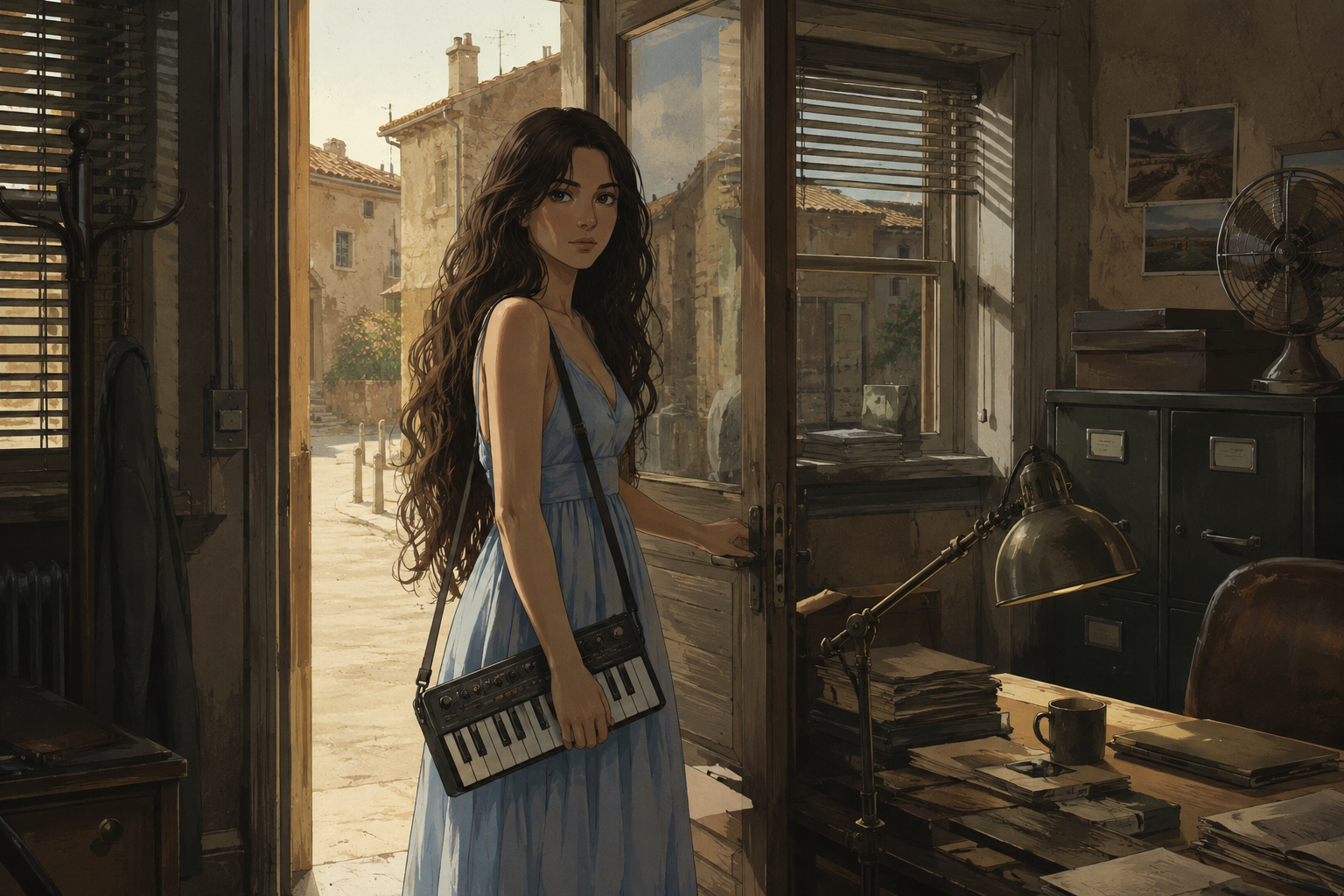
Light blue dress, long wavy brown hair, dark eyes. And she was carrying an instrument too — a compact synthesizer. Antony desperately wanted to throw out some sarcastic quip like, “What, is carrying an instrument the new dress code around here?” But he bit his tongue. She was, without a doubt, a client.
“Detective,” she began. “I need your help.”
“Most people who walk through that door have lost something — or someone. What can I do for you, miss?”
“I’ve traveled a long way, and I'm prepared to cover all expenses to bring you to my country. We urgently need a detective of your stature.”
“Your country? You came all that way?”
“I represent Tomo City, the capital and sole city of Jamlandia. Music is our nation's lifeblood — driving our culture, economy, and tourism.”
“Whoa, hold on. Where exactly is that?”
She pulled out a map. The country — or rather, the island — was nestled in the Caribbean Sea, not far from the Bahamas. Apparently, some corporate syndicate had bought the land and prospered enough to turn it into a microstate.
“Mr. Antony, the very future of our nation is at stake. Our head of state, elected for life, must prove his legitimacy every year by performing our national anthem. He uses a highly specific, one-of-a-kind instrument that no one else in the country possesses. If he cannot perform the ceremony, he is legally forced to resign.”
“Let me guess. The instrument is gone?”
“Nothing gets past you.”
“Could it have just been misplaced?”
“Listen, Detective. The instrument is kept under tight lock and key in a vault. When we opened it, we didn't just find an empty space. We found this.”
She handed him a card. The crime was signed. On it was a logo — a symbol the detective knew all too well, having seen it a thousand times in his nightmares.
O².
Without even knowing why, the words slipped past his lips:
“...them again...”
He shot up from his chair, shoved his phone into his pocket, grabbed his jacket, and barked:
“MATTHIAS! You're gonna get all the practice you want!”
His face darkened as he added:
“We're going to the land of music.”
Chapter 1

“We haven’t been properly introduced,” the detective said, settling into his first-class seat for the long-haul flight across the Atlantic.
“I am Melody Oxid, First Lady of Jamlandia. Yes, my husband is the head of state.”
“But how does your economy even function if everything revolves around music?”
“Music is the universal language, Mr. Antony. Frankly, the only reason we can even understand each other right now is because the author of this story hired top-tier voice actors. But music...”
Melody tapped out a sequence on her synthesizer with extraordinary dexterity, leaving Eric Antony utterly stunned. In just a few notes, she channeled more raw emotion than a Japanese melodrama.
“Music connects people, Detective. In fact, we should arrive just in time for the grand opening ceremony of the Jamlandia Conservatory — a state-of-the-art music academy and concert hall.”
“But tell me,” Matthias chimed in, “what if this famous instrument has already left the country?”
“Impossible. We’ve locked down all transit to the outside world. No one goes in or out without a government clearance.”
“Something tells me,” the detective muttered, a frown creasing his brow, “that won't stop them.”
“What are you talking about, Éric?”
“Something I haven't mentioned yet, kid. Tell me, do you remember the cases we handled back in 2025?”
“We barely had any, right?”
“...Exactly. Our 2025 archives are abnormally blank, Matthias. Something smells fishy if you ask me.”
“Come on, it was just a slow year.”
“Matthias, I'm telling you, something is off. Something happened in 2025. What? I don't know. But if I had to guess, someone drugged us to make us forget.”
“And you think it's connected to this new case?”
“Could be. You know me, I never back down from a challenge. But this time...”
“Hey, look on the bright side! Worst-case scenario, we get an all-expenses-paid beach vacation!”
The jamlandian envoy watched the exchange with keen interest. Detective Antony was certainly a colorful character, sporting a worn-out trench coat, a battered fedora, and a three-day stubble. He looked exactly like a hard-boiled detective ripped straight from a noir novel. His assistant, Matthias, on the other hand, looked utterly unqualified for the job. Strawberry blonde and laid-back, he had swapped his usual green sweater for a tacky light blue t-shirt featuring a cartoon sun wearing sunglasses and sporting a smug, provocative grin. He hadn't forgotten his cap either, which was curiously plain by comparison.
“I assume you import your food?” the detective asked.
“We have plenty of fruit and fish in our part of the world, but otherwise, you are correct. Besides music, our other major export is flowers.”
“Flowers?”
“We operate on the theory that flowers grow better when exposed to music. Classical concerts are regularly performed in our fields and greenhouses. And since we were on the subject of food, we also grow edible flowers.”
As small as it was, the detective thought, the country seemed remarkably resourceful.
After dinner, Antony spent the rest of the flight asleep. Matthias did not. He binged at least three movies and stepped off the plane running on fumes, earning a disapproving glare from his boss and an amused look from their client.
Arriving at Nassau Airport, they hailed a taxi to the coast and boarded a small motorboat, which finally brought them to their destination.
A car was waiting for them, and the detective couldn't hide his surprise.
“A Citroën AX?”
“We don't want to draw public attention with a limousine, so I requested an older model. Though you'll note the windows are tinted.”
While Matthias snored like a chainsaw, the detective gazed out the window. He had expected to see loudspeakers blasted on every corner, but the cityscape looked fairly normal — albeit surprisingly developed. The only real anomaly he noted was that almost every pedestrian on the sidewalks was carrying a musical instrument.
Deciding it was too early to judge the population on a fleeting glance, he flipped through the brochures the First Lady had provided. He learned that Jamlandia, officially founded on May 1, 2020, was one of the youngest nations on Earth. However, its founding settlers had arrived much earlier — specifically, on December 2, 2004.
The island’s founding group was the orchestra of a cruise ship that had sunk nearby. They initially spent two weeks stranded on the island before rescue arrived. Realizing that life there wasn't half bad, they decided to return on September 26, 2005, bringing along their families and anyone else willing to tag along.
On June 26, 2008, they struck a deal with a recording studio located in Japan — specifically in WaruWaru Town. Japanese musicians joined the settlement, bringing the logistics required to build a thriving community by exporting their music globally. As it turned out, the island possessed exceptional acoustic properties.
Twelve years later, in 2020, the WaruWaru Town syndicate shut down its label, GB Music Studio, and injected the necessary capital to fast-track the island's growth, allowing them to petition for microstate status.
“So, what about this instrument?” Antony asked, tossing the brochures onto his lap. “Can you give me any details?”
“Not really, to be quite honest...”
“What do you mean, 'not really'? Look, am I supposed to be investigating this or not? How am I supposed to track down a one-of-a-kind instrument if I don't even know what it looks like?!”
“We maintain a certain shroud of secrecy around the instrument. I would prefer you speak directly with my husband. Besides, we've arrived.”
They climbed out of the compact car.
“That's the presidential palace?!” Antony asked.
He was dumbfounded, and rightfully so. It wasn’t that the palace lacked grandeur; the architecture drew heavily from Baroque and Rococo styles. A flag fluttered overhead, displaying an orange eighth note against a brown backdrop framed in yellow. But the entrance didn't look like a palace gates at all. It looked exactly like a concert hall box office.
“Follow me,” Melody said, picking up the pace. “I'll show you to your dressing rooms, but let's hurry. I expect the Composer will want to see you immediately.
“The Composer?”
“Ah yes, I didn't explain. While we are technically a democracy with universal suffrage, we refer to our head of state as the Composer. Our founders initially wavered between that and the Conductor...”
The detective froze dead in his tracks.
“Mr. Antony? Are you alright?”
“No... no... there are too many anomalies here...”
The detective seemed paralyzed. An unspeakable force held him pinned to the floor. He quite literally could not take another step forward.
“Matthias... we need to talk. Seriously.”
But his assistant was already nodding off, of course. Taking pity on them, Melody Oxid quickly guided them along so Matthias could collapse onto his bed.
While waiting for his assistant to wake up, the detective brewed a cup of coffee in his own quarters.
The word Conductor had left the detective more rattled than ever, and he couldn't fathom why. It was a perfectly ordinary title in the music industry, after all.
Private investigator Eric Antony suddenly felt a surge of defiance. Nothing had even happened yet, but since the inception of this unbegun investigation, he felt crushed under the weight of an invisible hand — a force against which he seemed fated to lose.
Screw that. This time, he was going to win.
Chapter 2
“So, you’re the detective?”
“And you’re the Composer, I take it?” retorted Éric Antony.
While his assistant slept like a log, private investigator Éric Antony had requested and been granted an interview with the head of state.
Éric Antony was uneasy right from the start. Not that the Composer was particularly terrifying, but his appearance and stature awakened something deep inside the detective.
He was a tall man with short brown hair. Éric Antony had expected him to be carrying an instrument, but he wasn't. Instead, the Composer wore wireless headphones and a pair of dark sunglasses.
Ever since this whole business started, Éric Antony had been incredibly unsettled. He couldn't prove anything, of course, but he felt in his bones that something was wrong. That this investigation would never just go from point A to point B. And that either way, the mysterious group calling itself O² had left the country long ago — or worse, had left sleepers behind.
Stricken by a rapidly growing paranoia, it was a minor miracle that he managed to find his words and jump in.
“Your wife explained the situation to me. She also mentioned that you're the only one authorized to tell me more about this instrument.”
“Well, you see, this instrument comes from quite a distance. I believe you know our nation was indirectly born from a shipwreck. Melody is the daughter of one of those survivors, and the granddaughter of an exceptional luthier who used to work in America. We owe the creation of the Instrument to that very luthier.”
“But what's so special about it that you refuse to even tell me what kind of instrument it is?!”
“It's a state secret, and it seems this story has readers. We wouldn't want word getting out too quickly. What I can tell you is that it's a very small instrument, just slightly larger than a whistle, coated in fine gold, with the initials TJ engraved upon it.”
“TJ? Does that stand for something specific?”
“Those are the initials of Melody's late grandmother.”
“Fine. I suppose that'll have to do. Can I see where the Instrument was being kept?”
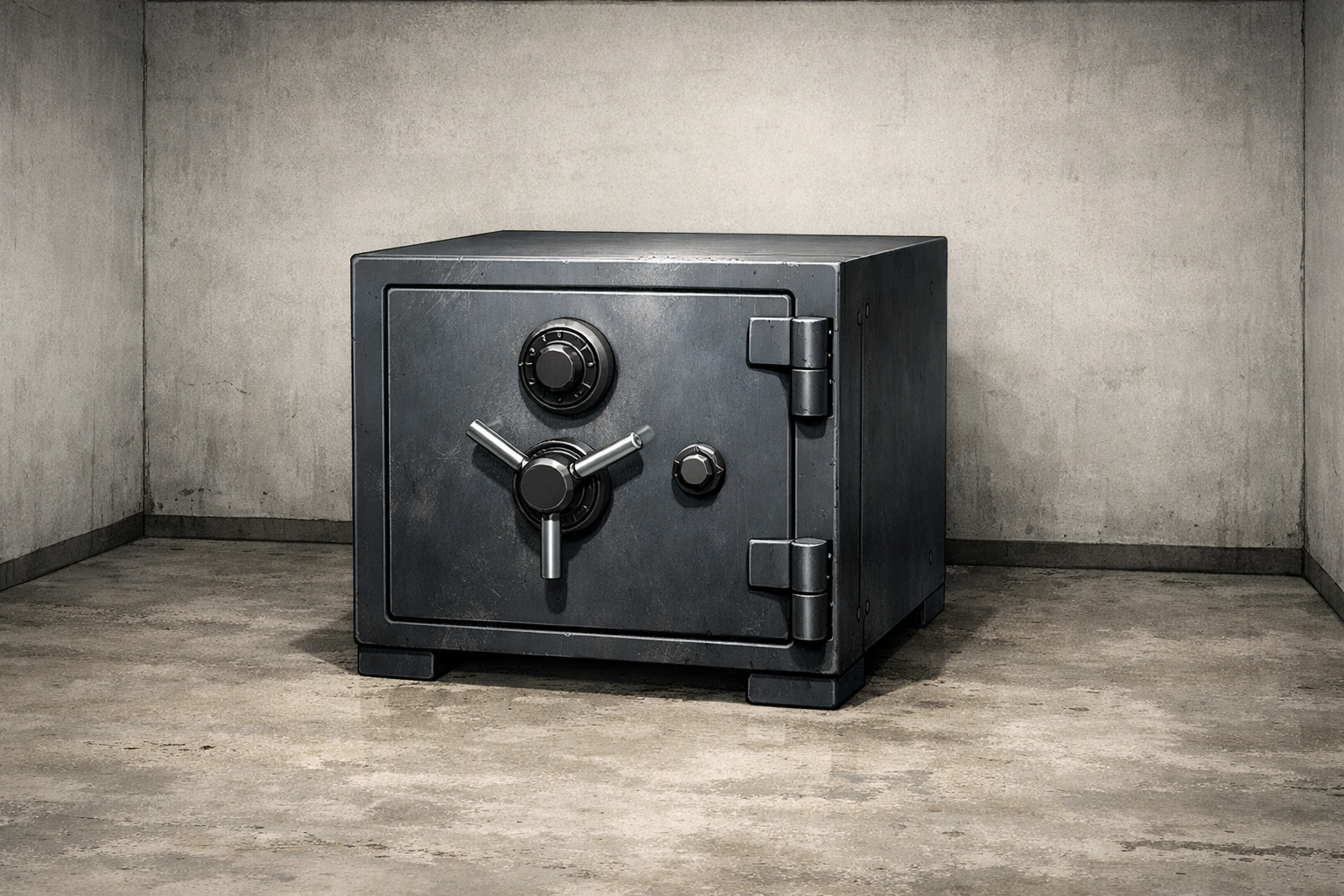
The Composer guided the private detective through a labyrinth of small rooms cluttered with instruments, stage gear, and sheet music. They arrived at a much more spartan room, right in the center of which sat a safe. To gain entry, the Composer utilized retinal scanning technology.
“How they managed to break in remains a mystery,” the Composer mused, looking thoughtful under the detective's inquisitive gaze. No, really, something was deeply off.
Éric Antony scrutinized the safe from every angle, inside and out. He even asked if it had a false bottom. The Composer nodded, though he specified that this false bottom had never actually been used.
“Can you open it?” requested the detective.
It was opened. And the detective arched an eyebrow. Because tucked inside the never-before-used false bottom of the most secure vault in Jamlandia lay an envelope bearing these unambiguous words:
To the attention of Detective Éric Antony
Subconsciously, the detective had expected something like this. This case felt like a rerun of... something, though he couldn't put his finger on what. He opened the envelope cautiously and unfolded the A4 sheet inside. The letter bore a very specific header.
OBSCURE ORGANIZATION
Tomo City, July 8, 2026
Detective,
Please have the courtesy to withdraw from this case immediately. You are wasting your own time, as well as the readers'.
This is not a threat. It is a simple observation.
Should you nevertheless persist and wish to cross swords with us once more, please rest assured, Mr. Antony, that we remain entirely at your disposal.
Sincerely, and awaiting your next move,
O²
The detective was fuming. This letter was proof — definitive proof that something had happened in 2025, and that it hadn't ended well for him. Thus, all his instincts were validated by a few well-placed words. He had formidable enemies, and he had no idea how to fight them. How do you combat an invisible threat when you're just a small-town private eye from the French provinces? And by what bizarre twist of fate had Éric Antony crossed paths again with the most complex startup ever conceived in the vast multiverse?
He didn't know, nor did he care to figure it out. He had realized something else. He understood the narrative cue he was being handed — because like it or not, Éric Antony was an extremely capable professional.
“Logically speaking,” he began, “I gather we are characters in a story. Which means the author, whoever they may be, has every incentive to keep things dramatic. Therefore, it seems highly improbable that any agent of the Organization could have left the country since the Instrument was stolen. So, Composer, I'm going to make you a promise.”
The camera pulled in tight on his face, executing what industry professionals call an extreme close-up, as he added with theatrical flair:
“I will find those thieves at the very least, or my name isn't Éric Antony, Private Investigator!”
“That would be absolutely wonderful,” the Composer replied. “And that reminds me...”
The head of state looked troubled.
“Actually,” he said, “we suffered another theft. We don't think it's connected, but still...”
“I'll be the judge of that. Tell me more.”
The Composer nodded and led the detective down a grand hallway. Hanging on the wall was a series of paintings depicting musical instruments in various artistic styles. However, there was a conspicuous empty space between two of the frames.
“Someone stole a painting?” the detective deduced without breaking a sweat.
“The most precious one we owned. Have you ever heard of Érasme Ennare?”
“The painter? What a peculiar name...”
“It's a pseudonym. No one ever discovered his true identity. This 19th-century painter once crossed paths with Camille Corot and became his pupil. Yet his subject matter was a far cry from anything his master ever painted. A medieval Czech village, a lost Aztec city, the Milky Way... those are just a few of his works.”
“...Huh? How is that even possible?”
“No one knows. He vanished in 1912 — already a very old man, admittedly — when the Titanic sank. Despite his advanced age at the time of his passing, he only ever produced about twenty pieces.”
“And you had one of them?”
“We owned 'Before the Show'. The artist had depicted a wide array of musical instruments across a stage. And featured among those instruments is the exact same type as the one that was stolen from us.”
“When was it taken?”
“Sometime last month, in mid-June, I'd say.”
“I think I'll start my investigation with this painting. Do you have computers with internet access?”
“Fortunately, yes. Otherwise, how would we share the creations of our most famous artist, DJ Daijoubu, with the world?”
Meanwhile, Matthias was dead to the world. He was snoring softly, in fact, but that wouldn't last long.
“Alright, up and at 'em!” the detective said, giving him a rough shake. “I've got work for you!”
Grumbling and rubbing his eyes, Matthias listened to what his boss had to say. Matthias was usually the one handling internet research, while his superior preferred boots-on-the-ground fieldwork. Besides, he hadn't come all this way just to sit around.
So Matthias got to work. He searched for everything he could find regarding the painter Érasme Ennare and the missing painting.
The detective went out for a stroll in the city. It was then that he truly began to realize the sheer, all-consuming presence of music in the daily life of Jamlandia. In a public square, he spotted a drum ensemble rehearsing. At a sidewalk café, he saw a man who had hooked a synthesizer up to a laptop, converting live notes directly into usable data to build an audio file.
Éric Antony walked into a record store and was blown away. CDs, vinyl, cassette tapes, MP3 players pre-loaded with tracks — not only did they stock every format imaginable, but they also carried artists whose physical releases usually command a fortune, like Swing Mômes or Less Than Jake. He even ended up leaving with a plastic bag containing the album Hello Rockview. Sure, it wasn't jazz, but hey, everyone deserves a little indulgence now and then.
Passing by a florist, he noted that the gentle notes of Beethoven's Für Elise could be heard drifting all the way out into the street.
Then he walked past the Conservatory.
While not quite as massive as the presidential palace, the Conservatory still possessed a distinct charm. Banners and flags announced the grand opening, which was scheduled for the very next day.
On his way back to the palace, Éric Antony noticed that extreme poverty seemed virtually non-existent on this little island — or at the very least, everyone seemed to have a roof over their head.
He found his assistant waiting for him, sporting a wide grin and holding a stack of printed pages. Éric Antony snatched the documents.
“Alright, what did you find?” he began, flipping through the pages.
“Just a single hit. The internet doesn't really know who Érasme Ennare is. Wikipedia doesn't have an entry on him, and the AI refused to tell me a thing.”
“A single hit is still a start,” the detective noted. “Wait... look at this!”
The info Matthias had printed out came from a website run by a group called Oneiric Origami. It was advertising an exhibition of the artist’s paintings. The coincidence was far too massive to ignore. The exhibition had been held in France just a week prior, and was set to open the very next day at an art gallery in Santa Monica, right on the outskirts of Los Angeles.
And featured among the listings was 'Before the Show'. According to the website, the canvas was on loan from a private collection in Vancouver, but the timing was just too perfect.
“What's the plan?” Matthias ventured.
“One of us needs to get to Santa Monica, while the other holds down the fort here.”
“But wait, aren't travel restrictions in place? No one's allowed to leave the country, right?”
“Use your head, you blockhead! Of course we're allowed to leave — we're working for the government! You need to infiltrate that exhibition, Matthias, by any means necessary!”
“But... but... my trumpet...”
“The trumpet can wait! Good grief, did you honestly think this was a vacation?”
And so, with official clearance to leave the country, Matthias headed to Santa Monica to infiltrate “The Possibles” exhibition and track down 'Before the Show' among the other works of Érasme Ennare. Was his adventure worth writing home about? No clue.
Chapter 3
The detective’s sleep quality wasn’t getting any better. That night, he dreamed of the Composer. But the head of state’s attire had changed. He was still wearing dark sunglasses and headphones. Over his open, short-sleeved jacket, layered over a light blue long-sleeved sweater, was the black O² logo.
He was accompanied by a man the detective didn't remember ever seeing before. Dressed in a blue suit that was slightly too large, the figure nonchalantly played with a purple fountain pen of extraordinary elegance. They seemed deep in discussion. Suddenly, he stopped and turned toward the detective.
“Detective! What a surprise! I didn't think I'd see you again so soon!”
Naturally unaware that he was inside a dream, the detective could only reply.
“Wait…” he began, “but… aren't you…?”
“Recognize me, old pal? What a pity, you won't remember any of this when you wake up.”
“You are… you are… but you're the author!”
“Yes! Bravo! If you only knew the torrent of imagination it takes just to have a little chat with you!”
“Explain yourself! I thought you were offering me a second youth, and instead…!”
“Don't worry, I'll get around to writing them eventually, your youthful investigations.”
“That's not the point! Ever since you had me step through that door promising me the world, I've been having horrible nightmares and I can't seem to remember anything that came before! Explain yourself, damn it! And who is this man?”
The man with the headphones gave a condescending smile. The author replied.
“Come now, after everything we've been through, you don't even recognize the Conductor, leader of the Obscure Organization?”
At 4:04 AM, the detective woke up in a cold sweat.
The author had warned him. He remembered nothing. But he felt more than ever that he needed to watch his back around the Composer.
When he got up, he felt in good shape regardless. Perhaps it was just the jet lag.
While he was enjoying a government-provided breakfast, Melody greeted him.
“Tell me, Detective, today is the grand opening of the Conservatory. My husband and I are spending the day there. Would you care to join us, or do you fear it might slow down your investigation?”
The detective took a sip of his coffee, then glanced over at the Composer, who was busy enjoying a piece of toast. The bread, he noted, was shaped like a saxophone, but obviously this cosmetic detail has absolutely no bearing on the rest of this story.
“…To tell you the truth, I don't have enough leads yet. Yes, I will accompany you.”
If only, he thought, to keep a close eye on the movements of this guiltily suspicious head of state.
This time, it was indeed an official limousine that brought the trio to the venue.
The Jamlandia National Conservatory was thus being inaugurated with great pomp that day. A national music school, an instrument shop of every kind, a media library, amphitheaters, and concert halls formed a whole that was both cohesive and ambitious.
The morning proceeded without any notable incident. A massive ribbon was cut by the Composer using a pair of giant scissors, and people ate finger foods and peanuts while congratulating one another.
Around noon, the detective received a call from his assistant. He had arrived in Santa Monica and located the May Gallery, where the exhibition was scheduled to take place. A tough-looking security guard, a mountain of muscle with a patch over one eye, was filtering the entrance, and only people with tickets pre-purchased on the exhibition's website were allowed through.
“Find a way to get your hands on someone's ticket,” the detective concluded.
After the meal, several novice music groups were scheduled to give their first public performance.
The Baroque Ensemble was widely acclaimed for its flawless rendition of Jean-Baptiste Lully’s March for the Turkish Ceremony.
Rock and Plot created a surprise with a bold blend of rock and roll and Latino music.
Kidz Metal also surprised the crowd by revisiting children's songs through a heavy metal lens.
The detective was beginning to think he was wasting his time when the final group was announced, a duo calling themselves… Oneiric Origami.
Éric Antony spat out the mouthful of water he was still holding.
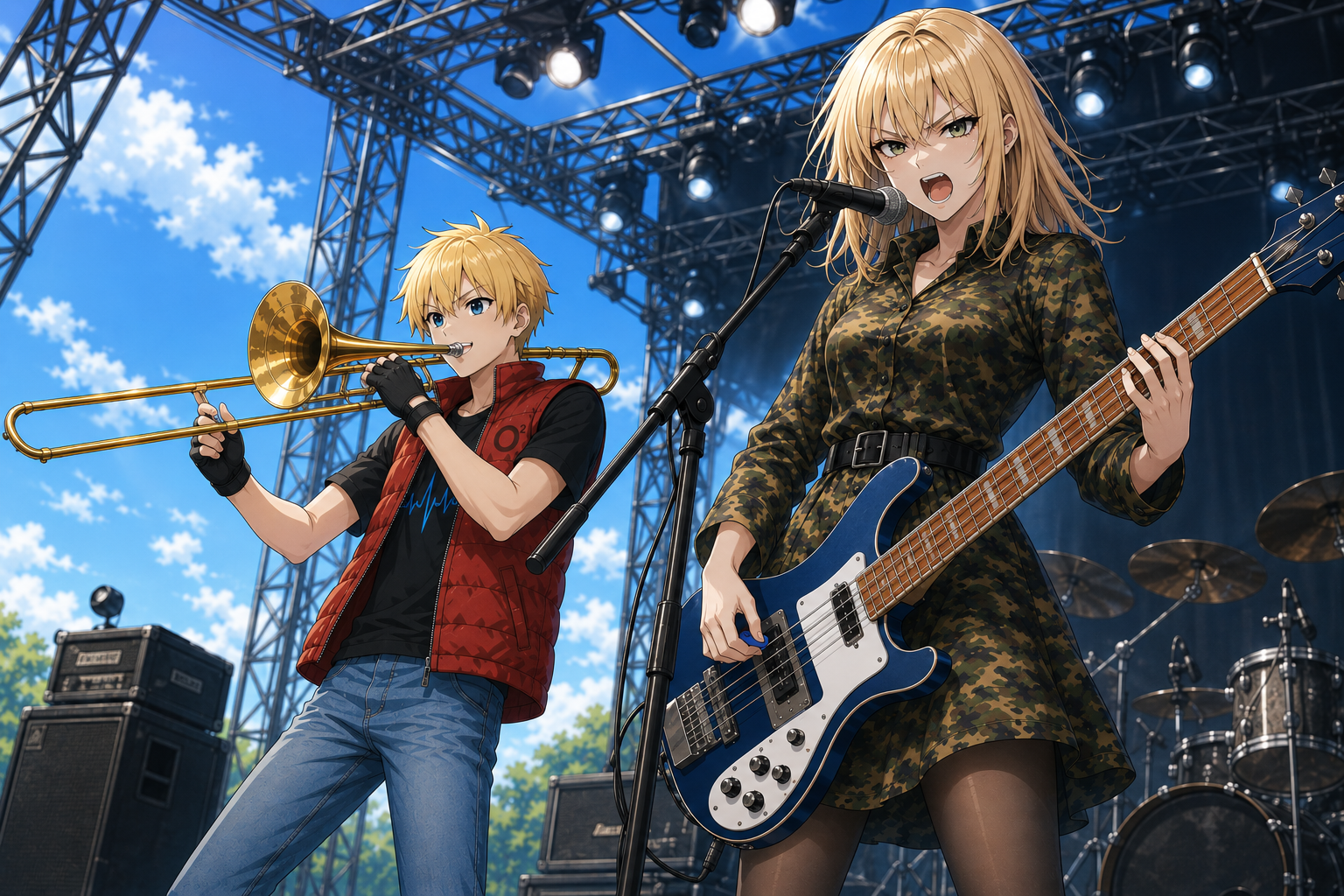
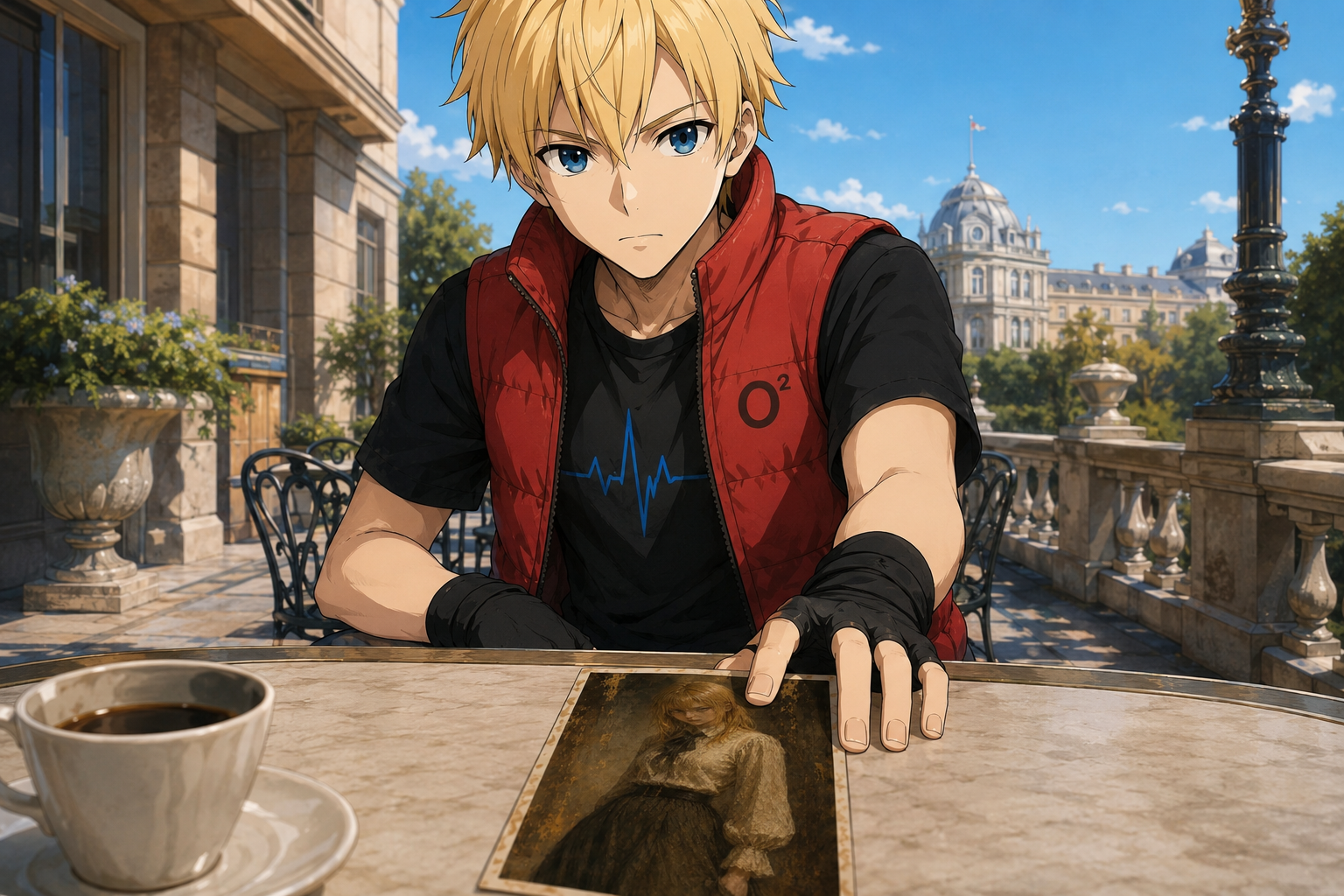
A young couple took the stage. The boy, a blonde kid in a black t-shirt featuring a blue audio wave, also wore a red vest, onto which was clearly sewn this darker logo:
O².
Carrying a slide trombone, he looked like a thoroughly pleasant person. Besides, he wasn't the one who caught most of the detective's attention.
For the young girl standing beside him was of an entirely different caliber. Also blonde, she had chosen a camo-style dress for her outfit. Her electric guitar, a left-handed Rickenbacker 4001, completed a particularly memorable look.
Her eyes met the detective's. And the detective shuddered.
Their performance, a wild track halfway between Californian rock and Japanese rock, interspersed with disturbing dissonances, won an exceptional standing ovation.
I have my suspects, the detective thought, glaring at them with a dark look.
As the duo prepared to perform a second piece, the detective noticed that the boy had briefly glanced offstage. Éric Antony followed the direction of his gaze and spotted a very thick backpack, resembling a military pack.
The detective stood up. He had to take advantage of the concert to search that bag. It was perhaps his best shot.
The girl was giving it everything she had. Not only was she playing the electric guitar, but she was singing too. The second track performed by Oneiric Origami this time was a heavy-metal-infused rock song, coupled with a highly daring reinterpretation of two famous children's nursery rhymes, London Bridge is Falling Down and Old MacDonald had a Farm.
Éric Antony didn't even try to be discreet. He knew he had very little time. He ran, spotted the backstage entrance, and rushed inside. He had the backpack in sight.
He lunged for it. Grabbed it. And took off with it like a common thief.
He ran even harder. He had noticed that while the show was still going on, the trombone had stopped playing. He reached the presidential limousine. The chauffeur was leaning against it, smoking a cigarette while waiting for the concert to end.
Éric Antony called out to him.
“The future of your country is at stake! This is a piece of evidence! Hide me, right now!”
Taken aback, the driver opened the door for him, then started the engine to take him back to the presidential palace.
Sweating profusely, Antony, finally safe, took the time to inspect his prize.
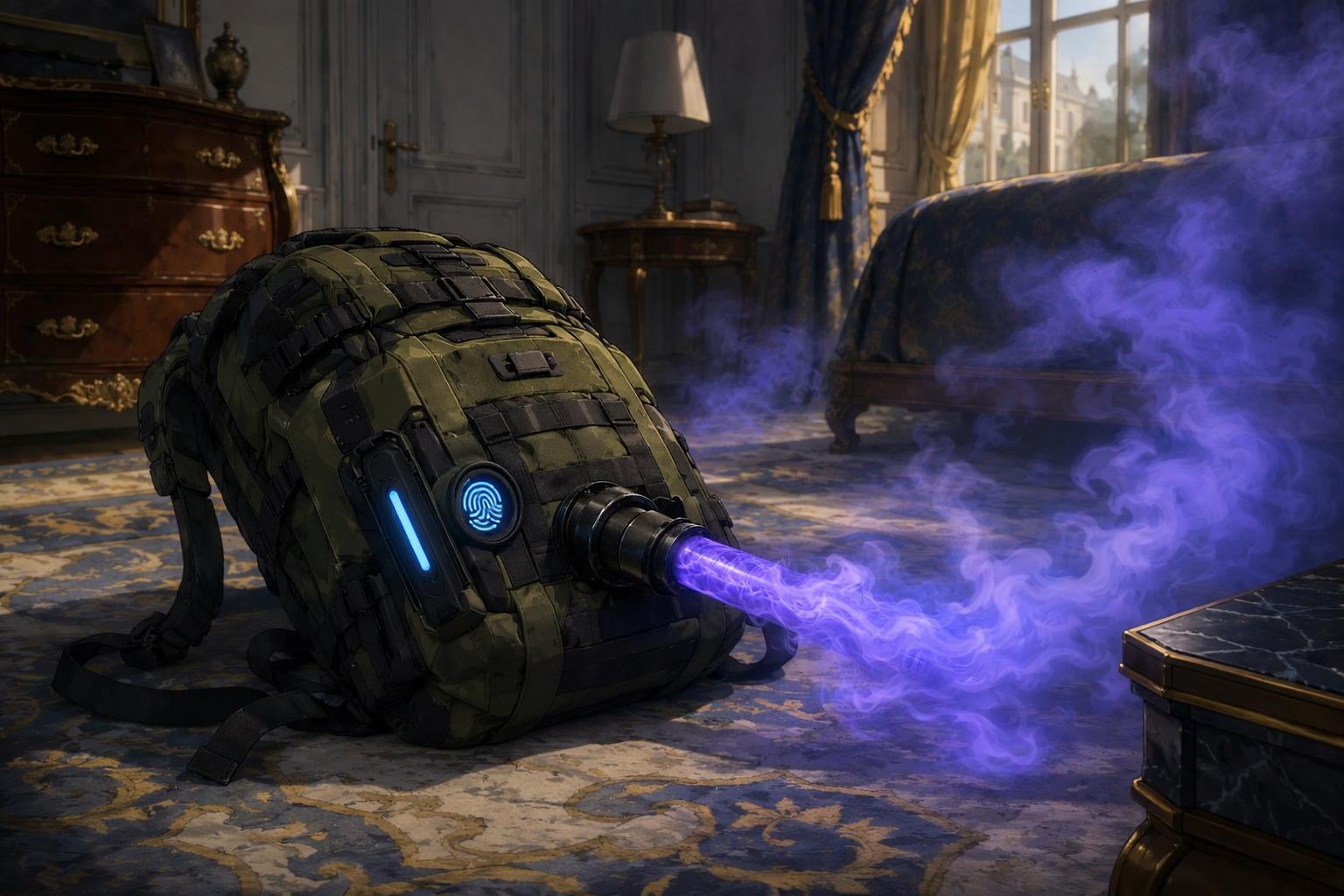
This bag wasn't just military-style. It also had a certain futuristic quality about it. Éric Antony realized he couldn't figure out how to open it.
“I'm certain of it,” he muttered, “the Instrument is in this bag!”
Looking at it from every angle, he noticed a sort of button next to a small LCD interface. He pressed it.
And a countdown began. Tick, tock, tick, tock.
The detective knew only too well what that meant.
Chapter 4
It was too late. The countdown wasn't at a minute. It wasn't even at thirty seconds.
It was at five.
The detective barely had time to pull himself up.
But against all odds, there was no explosion.
A canister slid out of the bag. And from that canister hissed... gas.
“Hell!” the detective cursed. He bolted for the door, desperate to escape — but in his panic, he'd forgotten he'd locked himself in.
Maybe a different choice would have saved him. Instead, he lunged for the windows, but it was already too late: his heavy, sluggish steps didn't get him there in time, and he blacked out. That was the exact moment his assistant chose to call, but of course, the phone rang in vain.
He woke up in a pitch-black room. He waited for his eyes to adjust, scanning the gloom.
There was nothing to see. He could barely make out the outline of a chair.
The sound of a door clicking open and shut cut through the silence. On high alert, he spun toward the noise. A young woman's voice broke the quiet.
“How long has it been, detective? Thirteen years, I think... well, thirteen years for me. For you, it's much more recent... and the tragic irony is, you can't even remember...
“Show yourself!”
“Why not, after all...”
The lights flickered on. Éric Antony wasn't surprised: he was staring at the singer in the camo dress. She had propped her guitar against the bare wall of a nearly empty room containing nothing but two chairs and a table.
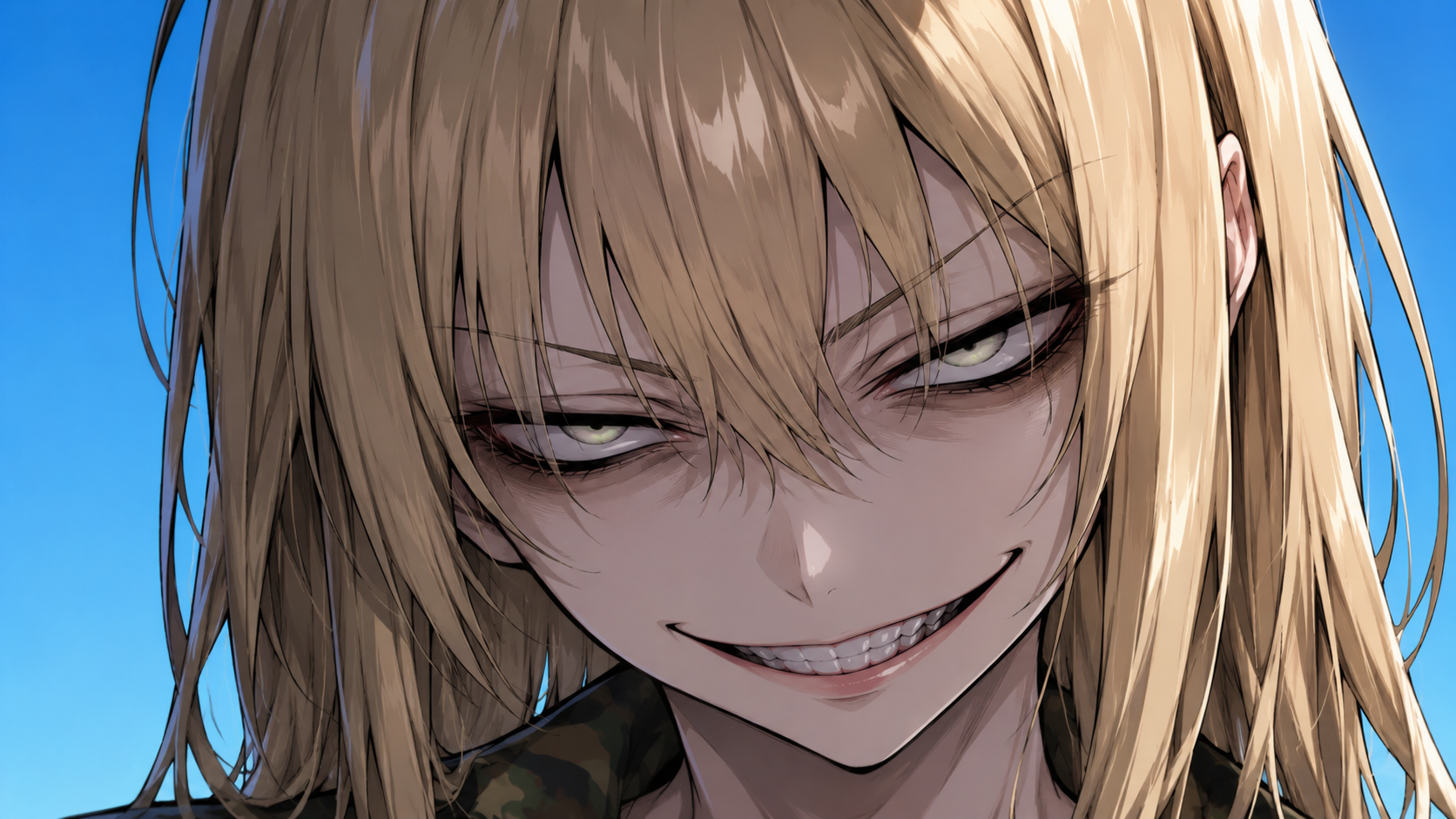
“Unfortunately, I'm not authorized to turn this story into a horror movie. But,” she said, a twisted, sadistic smile warping her features as she slipped a knife from her pocket, “a few scars wouldn't hurt.”
She lunged at him with sudden ferocity. In her eyes, he saw the spark of pure, unreasoning madness. She slashed at his face, but Antony managed to block the blow and grab her wrist.
“You're going to DIE, you bastard!” she screamed, driving her knee hard right where you'd expect. The shock forced the detective to let go, stumbling backward in pain.
She threw herself at him again.
“DIE!” she shrieked, her first wild slash cutting only air. “DIE!!” she screamed, aiming for his throat and missing by a hair.
“DIIIIIIIE!!!” she roared as the detective ducked, dodging the third strike, and swept her legs, sending her crashing to the floor.
“That's enough!” the detective growled, wrenching the knife from her grasp. On the floor, she glared up at him, her eyes burning with a venomous rage.
“Let me tell you something, Detective Antony. In another life, maybe we could have worked together. But after what you did to me in 2025...”
The detective kept the knife leveled at the young woman to keep her back. She sneered.
“Ha! Ha ha! You really are clueless, aren't you!”
“Enough!” Éric Antony spat. “I don't even know where to begin with this crazy talk, but you're going to start talking! First off, how did you find me? And where are we?”
“Seriously? You steal a bag loaded with high-tech gear, and you're asking how we tracked you down? As for where we are, we didn't exactly have time to get fancy. You were about to wake up, so we just tossed you into an empty room in the palace.”
The detective suddenly realized how close he'd come. If his captors had had a little more time, he might well have woken up hogtied to one of those chairs. And in that scenario...
“Fine! What did you do with the Instrument?”
“You know what, detective? I'll tell you, and it's going to blow your mind. I'll tell you because I know it's going to plunge you into absolute despair. The Instrument? Yes, we wanted to steal it. No point hiding it anymore — Oneiric Origami isn't a convincing cover against a stubborn bastard like you.”
“And?”
“We cracked the safe. I won't tell you how, though. But we opened it. And guess what... the Instrument wasn't there.”
In the distance, a piano struck a dramatic, tense chord. The detective knew, he could see it in her eyes — she had no reason to lie. But if that was true... who had the Instrument?
The girl stood back up. She looked down at the detective, completely unfazed, as if she had nothing to fear from him.
“You used to know me, Éric Antony. In fact, you tried to end my life. But of course, you don't remember. In a way, I envy your ignorance. Next time, I won't miss.”
She backed away cautiously, grabbed her guitar, and slipped out of the room.
The detective, caught completely off guard by this turn of events, took a few seconds to react. A few seconds too long. By the time he went after her, the woman he'd been fighting moments ago had vanished.
That was when he realized he had no idea where he was. Sure, she'd said they were in the presidential palace, but he'd only arrived the day before and hadn't explored the place.
It took him a long while to find his bearings, but once he reached familiar territory, he finally made it back to his room.
There, he spotted his phone on the floor. It must have slipped from his pocket when he collapsed.
Powering it up to check the time — only half an hour had passed since he'd passed out — Éric Antony saw the damage: his assistant had tried to call him five times, without leaving a single message.
The detective rolled his eyes.
“How many times,” he grumbled, “do I have to tell him to leave a voicemail...”
He dialed back. His assistant picked up.
“Alright, Matthias, what's new? What was so urgent that you had to blow up my phone while I was staring death in the face?”
“Uh... what?”
“Never mind. What's happening in Los Angeles?”
“With the time difference, I landed at seven in the morning. By the time I located the gallery and called you for the first time around nine, the opening exhibition was still going on, but I got lucky: someone stepped out. I followed him, and... well...”
“You stole his ticket?”
“Uh, yeah...”
“Don't beat yourself up, kid. There was no other choice. I just hope they don't check names.”
“No, we're good on that front.”
“And you walked right into the lion's den?”
“Éric, I've never seen anything like it. These paintings aren't just weird. There's no way a nineteenth-century artist could have painted stuff like this. Yet, every single canvas comes with a certificate authenticating the period.”
“Really?”
“You should check their website, they've got photos of every piece. I don't know where this is leading us, but it might be worth taking a look.”
“And the one from Jamlandia?”
“It's here, I can confirm that.”
“Alright. Listen. There's not much else to do. I'll warn the Composer. You get out of that gallery, I don't want you getting into trouble. But stick around.”
“There's a cafe right across the street. I grabbed a table on the terrace.”
“Perfect. Keep an eye on the place. If anything shady goes down, don't hesitate to move. Hang in there.”
The detective hung up and made his way to the palace computer rooms, his limbs still heavy from his recent ordeal. Powering up one of the terminals, he opened the browser and went to the exhibition's website, which his assistant had sent him.
He looked at each painting, one by one. From Woodfire in the Forest to Journey to Bordeaux and even The Devil, nothing escaped his sharp gaze. And that's when he made a discovery that nearly made him shout in disbelief.
An undated painting was titled “Portrait of the Woman with the Disturbing Gaze.”
In every possible way, it was the singer from Oneiric Origami.
Chapter 5
Exhausted, the detective wanted to grab some sleep. He didn't just lock his bedroom door — he barricaded it completely with a chair. The Obscure Organization had just proven to him that a locked door meant absolutely nothing to them.
He collapsed, drifting into another fitful sleep plagued by the nightmares that had become his daily routine lately.
He woke up around 6:00 PM, drenched in sweat as usual, and checked his phone — no updates. Opening his door, he came face-to-face with the Composer. Standing beside him was the other half of the duo known as Oneiric Origami, carrying a backpack. Although he'd looked like a perfectly decent young man on stage, as amiable as his own assistant Matthias, the detective couldn't help but notice the smug confidence practically oozing from him now. The kid ran a finger slowly across his throat in a chillingly clear gesture: “If you talk, you're dead.” Éric Antony held his gaze. He couldn't believe the sheer nerve of these people, just hours after the events that had unfolded earlier.
“Mr. Antony, we've been looking everywhere for you.”
“...and this young man is?”
“Ah, where are my manners? This is Finn, the trombone player for Oneiric Origami.”
“Just Finn? Doesn't he have a last name?”
The young man's polite smile slipped back into place, and he answered for himself:
“It's too complicated for an English-speaking reader. Since the author refuses to localize names...”
The detective sized up his two companions. The feeling of having walked into a lethal trap grew heavier. He felt like an explorer who, after dragging himself out of quicksand, finds himself stuck to a giant spiderweb — the kind spun by those Australian monsters that crush any hope of a long, happy life. But Finn spoke again.
“I think there's been a misunderstanding. While my girlfriend and I were on stage, I saw you take my bag and walk off with it. Naturally, I had to put down my trombone and run after you.”
“By the way,” the Composer chimed in, “your girlfriend... what was her stage name again...”
“the Psycho, Composer.”
“the Psycho, right. She handled herself beautifully after you left her.”
The singer's stage name was another shock to the detective's system. He kept his face blank, but it was clearly another fragment of his stolen past. What the hell happened in 2025? And what did the girl mean when she said they'd met thirteen years ago? The detective eyed them warily. The Composer spoke up again.
“In any case, Mr. Antony, we are in a state of absolute emergency, and from what I gather, you've conflated this band with the organization you're investigating. I understand. We all do. What you did has no legal backing, but given the urgency of the situation, I wanted to let you know we won't be pressing charges.”
“...Understood. Thank you.”
“We took the liberty of checking the young man's bag, with his permission. We found nothing.”
“I see.”
The detective was cornered. He couldn't spill everything he knew, everything he'd just been through, because he had no idea what Finn was capable of. The kid offered a friendly smile and stepped closer.
“Come on, no hard feelings! Let's shake on it and call it even.”
The detective shook the kid's hand with zero enthusiasm. As they gripped, he felt something slide into his palm. A slip of paper. The other half of Oneiric Origami was passing him a note.
“Well, I'll leave you to it. Got to get to rehearsal!”
And with that, he was gone.
“And your investigation?” the Composer ventured.
Éric Antony stared at him. He didn't trust his employer — not one bit. But the man was still, after all, his client.
“I only targeted this band because they share a name with the group that likely stole your painting,” he began. “But I have to admit... until proven otherwise... I was barking up the wrong tree.”
“That's unfortunate. Tomorrow, we'll only have five days left. I'm not particularly keen on being forced to step down. The State has contingencies for this sort of crisis, so we won't be left leaderless, but still...”
“Listen, Composer. I'll see this through to the end. No matter what.”
“I know. That's why we hired you.”
Once the Composer had left, Éric Antony unfolded the paper.
“July 10th. 8:08 at the Musical Chair.”
Not even questioning the bizarrely specific time, a quick search on his GPS led the detective to the Musical Chair, a themed bar not far from the palace.
At 8:30 PM, he was already there having dinner to scope out the place. Right in the middle of his meal — a ribeye steak marinated in thyme and olive oil, seared with garlic, served with home fries and sunny-side-up eggs — his phone buzzed with a text from his assistant.
“The One-Eyed is heading toward me. I think he's figured something out. I'm splitting.”
“Be careful,” his boss shot back, a knot of worry tightening in his gut.
He didn't sleep a wink that night. Part of it was the long nap he'd taken that afternoon, but mostly he was worried sick about Matthias. Still no word.
At 7:30 AM, he left the palace to head back to the bar, walking in at 7:58 AM. Perfect, he figured — ten minutes early for this weird appointment. It gave him enough time to bag a seat with his back to the wall. A knife in the back is too easily done.
He ordered a coffee as black as a moonless night, gave a look of pure contempt to the sugar packet and the little pitcher of milk, and took a sip.
At 8:00 AM sharp, the regulars started trickling in. And at exactly eight o'clock, eight minutes, and eight seconds, Finn Decharjeman (our apologies to English readers) took a seat across from the detective.
He propped his trombone against the wall and offered a pleasant smile. The detective hit him with his sharpest glare. Two whole minutes dragged by. Finally, Éric Antony broke the silence.
“You have something to tell me, kid?”
“I think we should team up, detective.”
“Your girlfriend tried to carve me like a turkey.”
“Not her fault. You should let it go.”
Silence fell again. Antony took another slow sip of coffee, measuring the kid up. Finally, he spoke.
“What happened last year? In 2025?”
“To be honest, I'm not really sure.”
“Let me get this straight. You weren't there, is that it? But your girlfriend clearly was.”
“It's in the past. We weren't sent here to play out this script a third time. There are bigger things at stake.”
Unzipping his bag, he pulled out a postcard, laid it on the table, and slid it toward the detective. It depicted the painting by Érasme Ennare, “Portrait of the Woman with the Deranged Gaze.”
“We have to find the Instrument. If we don't, this painting will cease to exist.”
The detective stared at his companion, eyes wide, looking at him the way you'd look at someone who just claimed Golden Sun 3 was a good game.
“...What kind of crazy talk is this, kid?” he managed to sputter. But Finn's expression was so deadpan serious that the rest of his words died in his throat.
“It's a pity you don't remember 2025,” Finn finally said. “It would save me a lot of explaining. But there's no helping that, I suppose. So, I'll have to tell you about the Obscure Organization.”
“I'm listening. Make it good.”
“How to put this... we are a near-omnipotent syndicate, controlling the greatest power of all.”
“Uh... nuclear weapons?”
“The narrative. Surely you've noticed the anomalies since this story began. Extreme close-ups, top-tier voice actors, a soundtrack swelling right on cue — and all of it happening with the quiet complicity of the cast. Admit it, that's not something you see every day.”
“I have to say, since this whole case started, I've felt completely out of my depth...”
“Have you even realized that you're no longer in your original world?”
The detective's already wide eyes stretched even further. What kind of nonsense was this crackpot babbling now?
“Yet, it is the absolute truth, detective. Promenade-les-Pins, your hometown, the place where you set up your agency — it was an anomaly planted by the author. He wanted a detective in his story. That is the sole reason you exist.”
“But... what... what kind of madness is this?”
“Madness, really? Promenade-les-Pins and the country we are in right now share one thing in common. In the author's world, both of these places are completely fictional.”
The detective took another gulp of coffee. He couldn't believe he was sitting here listening to such incomprehensible nonsense.
“Well, fine. Let me force you to accept the unacceptable. Take a look at my ID. Check the birthdate and the expiration date on the card.”
He handed him a small electronic card — a French national identity card — which the detective snatched instantly. For context, this story, unfolding in real-time with its writing and narration, is set in July 2026.
Yet, on Finn Decharjeman's ID card — which was undeniably genuine — the following details were clearly legible:
“Date of birth: 28/08/2028.
Expiry date: 07/04/2052.”
The detective's head began to spin.
“We don't just come from another world, detective. We come from the future.”
Chapter 6
“Tell me, Detective, have you ever read H.G. Wells, or watched Back to the Future and its sequels?”
“Huh? I know the movie, yeah. Why?”
“Wells tells us there is no difference between Time and any of the three dimensions of Space except that our consciousness moves along it. The theory Wells developed, which Back to the Future borrowed, treats time as a straight line, just like spatial dimensions. Hence the idea that a time traveler shouldn't change geographical coordinates.”
“I'm with you so far.”
“The person running the Organization took that theory and pushed it even further on their own. What happens when you alter an event in the past?”
“According to the movie? Chain reactions, time paradoxes, and maybe people fading out of existence.”
“That's one way to look at it. But look at Back to the Future Part II. What happens when the bad guy gets his hands on the sports almanac in 2015 and hands it to his past self in 1955?”
“Time gets rewritten, creating an alternate reality.”
“Exactly. Now, imagine the hero's original reality still exists somewhere. Because it does. A time paradox is nothing but an illusion, Detective. The flaw of the DeLorean as a time machine is that it only navigates four dimensions — three of which are restricted by the fact that it's just a car.”
“Hold on... four dimensions? Wait, you're not seriously going to...”
“Why not? Welcome to the Organization, Detective. To reach our goals, we don't think in four dimensions, but five. Want to hear the craziest part?”
“The craziest part? I'm not sure you can top a revelation like that.”
“Oh, I can. We call the fourth dimension Time, and the fifth Reality. There isn't exactly an infinite number of Realities, strictly speaking, because certain constants remain unchanged. But the number of Realities keeps growing anyway, for one simple reason.”
“And what exactly is that reason?”
“Here it is: every piece of fiction ever created spawns a new Reality, or naturally weaves itself into one or more existing ones. Only by thinking in five dimensions instead of four can you truly grasp the scale of what second-rate authors mistakenly call the ‘multiverse.’”
“Fine. Let's say I believe you. What exactly is going on with the Instrument?”
“We were supposed to secure it and bring it back to headquarters. Then, the Psycho was meant to take it to the nineteenth century, to Érasme Ennare.”
“The painter!”
“Yes. Years later, after the sinking of the Titanic, he remembers the Psycho and paints her portrait.”
“After the... but... but he died in the shipwreck!”
“In this Reality, yes.”
The detective sat there, speechless. His companion, who had finally been served his hazelnut milk hot chocolate, took a sip before going on.
“The portrait was painted in a Reality where he survives the shipwreck and dies in the Santa Monica gallery where the Organization is exhibiting his work right now.
“Wait... so the painting stolen from here...”
“Oh, no, that one isn't ours, as you might guess. I have no idea who stole 'Before the Show' in this Reality, but if you ask me, it's tied directly to the disappearance of the Instrument. Anyway, the Organization retrieves the portrait and brings it into this Reality so a member of the orchestra on the MV Ocean Majesty — the ship that sank — can see it. That triggers a chain reaction that ultimately leads to the creation of Jamlandia. As for the Instrument, nobody ever built it. It's in a perfect causal loop. We need to find it to ensure Jamlandia is created.”
“But... but I have to find it for the Composer!”
“That's a problem. If you hand it over to the Composer, Jamlandia will never exist.”
The detective's coffee didn't survive the conversation. By his next sip, it was ice cold. But since he wasn't using that coffee to travel back in time via a mystical chair, it didn't really matter.
“And it's going to trigger a snowball effect you won't see coming, Detective. Have you ever heard of the morphogenetic field?”
“What kind of concept is that supposed to be?”
“A parascientific theory. It suggests that collective memory isn't stored directly in our brains, but rather like computer data on a remote server. Under the right circumstances, people with extraordinary perception can tap into this collective memory.”
“Huh?”
“Documented since 1922, the theory was notably studied by Rupert Sheldrake and Kotaro Uchikoshi. In practice, the morphogenetic field has mostly allowed humanity to create numerous works of fiction. Because while fiction breeds Realities, the reverse is also true. Realities breed fiction.”
“You seem to know your stuff, kid.”
“I learned from the best. My mother is the narrator, you know.”
“You've thrown a hell of a lot of information at me in a very short time. Detective or not, it's a lot to process.”
“I'm not done. I brought up Time, Reality, and the morphogenetic field for a reason, Detective.”
Right then, the Psycho burst in. She leaned over her boyfriend, kissed him, and dropped ungracefully into the next chair. The detective was dying to question her, but her timing was lousy: Finn wasn't finished with his lecture.
“Hey, babe,” she broke in, “do you really have to spill everything like this?”
“Instead of trying to whack him, how about you try working with him, just this once?”
The girl in the military dress pouted — an expression that might have been cute if she hadn't repeatedly tried to knife the detective the day before.
“So?” the detective pressed on, completely unfazed. “The morphogenetic field?”
“Let's take a concrete example. In a certain Reality spawned by fiction, a man travels through time for the sole purpose of posing for paintings. That time traveler had a massive impact on the morphogenetic plane.”
“How so?”
“For starters, when he was sentenced to death for witchcraft back in the Middle Ages, a painter captured that execution a few centuries later. Then, in the early twenty-first century, a comic book artist tapped into the morphogenetic field and illustrated the story. That's when the fiction generated this Reality — even though it technically existed beforehand. Without that connection, neither the comic nor the painting could ever have existed. But it doesn't stop there. You've seen Érasme Ennare's paintings, right? They're all displayed on the Oneiric Origami website.”
“Yeah, I've seen them.”
“That time traveler is the subject of his second canvas, ‘Le temps d’un café’. But here's the kicker: that canvas was only painted in the Reality where the painter survived the Titanic.”
“Then it shouldn't even be here?”
“And yet it is, for the exact reason I just explained to you.”
“...You moved it...”
“Alright, honey,” the Psycho cut in, “you're sweet, but can you wrap it up?”
“I'm getting there, I'm getting there. Jamlandia exists in this Reality, Detective, make no mistake. But Jamlandia is born from a causal loop set in motion by the Organization. If we fail to establish that loop, a rare and extremely dangerous phenomenon will occur: our entire Reality will collapse in on itself and vanish. If that happens, in the author's world, the video game Tomo Jam! will never see the light of day. The author will never access the morphogenetic field to orchestrate this tale — a tale he merely echoes through my mother, the Oratrix.”
The detective pinched the bridge of his nose. He really didn't like where this was going. Eyeing his companion, he said aloud what some readers were probably thinking to themselves.
“It's convoluted. The Composer swore to me that the Instrument was a family heirloom from his wife. Why should I believe you?”
“The real question, Detective,” the Psycho suddenly countered, “is why you should believe him. What makes you think he told you the whole truth?”
The detective fell silent, lost in thought. Because even if this girl — clearly a genuine psychopath — had tried to end his life the day before in a deeply unsettling encounter, her point was valid. There was something about the Composer that didn't sit right with Éric Antony.
“When it comes down to it, my job is still to bring him the Instrument.
“No. When it comes down to it, your job is to FIND the Instrument.
“If I don't bring it back, he loses his status.
“If you bring it back to him, you'll wish I'd finished the job.”
He narrowed his eyes, studying the Psycho.
“What did I ever do to you, kid? What happened in 2025? If you two really are from the future, how old were you?”
A predatory grin spread across the girl's unsettling face.
“I wonder if what I'm about to say will traumatize you, Detective. Or if you won't give a damn. If it's the latter, maybe the real psychopath here isn't the one everyone thinks.”
The detective and the girl locked eyes, sizing each other up.
“I was already from the future. I was seven and a half years old. You realized that if you stopped my parents' marriage, it would cause a paradox that erased my birth. You hoped, in vain, to put an end to the project the Organization was working on back then. So? How does it feel to know that?”
As absurd as it sounded, the detective couldn't bring himself to doubt her. It had happened. He had no doubt about it. And even, he reasoned, if he had to do it all over again...
A bead of sweat rolled down his cheek. Confronted with an undeniable past, he felt no regret. After all, the girl whose very existence he had tried to erase was now taking a sadistic pleasure in tormenting him. And he hadn't forgotten the three times she had tried to murder him the day before.
“Are you hurting, Detective? Tell me, does it hurt?”
“Émilie...” Finn tried to reason with her.
That name dealt another blow to the detective. Because he was certain of one thing: he had heard it before.
He stood up abruptly and bolted for the bar's restrooms. Two pairs of eyes watched him go — one anxious, one sadistic.
Leaning over the sink, he felt a long vibration. His phone. He had turned off almost all notifications, so he knew exactly what this meant: Matthias was calling. He picked up.
“Matthias,” he began, keeping his voice as low as possible. “Change of plans. The lead you're following was just blown to pieces right in front of me.”
“Uh, I've got something a bit more urgent here...”
“What? Speak up, damn it, I can't hear you!”
“I can't! I'm hiding behind a crate! The One-Eyed is coming!”
“Damn it, Matthias, what kind of mess have you gotten yourself into??”
“Too long to explain, but I've got the painting!”
“What?! But... but... I told you not to take it!”
“...It would've been stupid not to! Even if it turns out to be a fake, it's bound to give us a clue!”
“Yeah, maybe! But now you're in a tight spot! How do you plan on getting past the guard?”
“I... I don't know... uh... oh! Oh, shit! I have to hang up!”
The line went dead.
And a spark of anger began to smolder in the detective's chest.
“Oh, you want me to cooperate? You want me to cooperate? I'll give you some damn cooperation.”
The fire of his youth flashed back into his eyes. Anger seemed to sweep away all his regrets, all his hesitation. He stepped out of the restroom and reclaimed his seat. Staring Finn straight in the eyes, he spoke first.
“What's the plan?”
Chapter 7

Finn pulled a marble-like object from his pocket and set it on the floor. The Psycho stood up. The detective kept an eye on her.
Finn grabbed a pitcher of water from a nearby table — it was shaped like a taiko drum — and poured water over the marble. The marble dissolved, expanding into a sphere flush against the floor, glowing with a soft purple light.
Japanese culture teaches us to always remember that human nature is complex, driven by motives, and that concepts like good and evil don't truly exist. The Obscure Organization is made up of unsavory characters. You'll find killers, prison inmates, petty middle-managers convinced of their own superiority over their underlings.
You'll also find perfectly ordinary people. No one passing me on the street, or bumping into our costume designer at a fashion show, would ever think, “Hey, there goes someone working for a criminal syndicate.”
Japanese culture also teaches us that purple is synonymous with death. That's why certain Western works of fiction undergo strict color censorship when imported into the Land of the Rising Sun.
Yet here, the author wishes to lean into the former theory. If, under the unyielding laws of yin and yang, nothing is purely black or white, then purple can be ambiguous too.
The detective wasn't Japanese. He stared with genuine fascination at the thing the young man had conjured up in two deft moves. He almost forgot to keep his eyes on the Psycho.
“After you, Detective.”
“What do you expect me to do?”
“No, wait, Finn, he's gonna be suspicious. Better if I go first.”
Without giving anyone time to react, the Psycho stepped onto the glowing sphere with both feet.
“See you in a second,” she said, and vanished.
It hadn't been a flash of special effects. She was just gone. Just like that. Like a character in a poorly coded video game.
“Where does this contraption lead?”
“You'll see, Detective. It's not like you have a whole lot of choices anyway, do you?”
Grumbling, the detective downed the rest of his ice-cold coffee in one gulp, slapped some coins on the table, and stepped onto the sphere. Nothing happened.
“Blink,” his companion noted.
He did. One blink later, he was somewhere completely different. Somewhere that felt oddly familiar.
Dusty offices packed with cardboard boxes. Through the windows, a beach was visible. But this wasn't Jamlandia anymore. In an instant, he had crossed borders and Realities, landing in a place he had set foot in once before.
The Organization's headquarters.
Perched backwards on an office chair with her hands resting on the backrest, the Psycho was watching the detective.
“It would've been hilarious if that was a trap,” she remarked.
Before the detective could answer, Finn popped into existence alongside them.
“We need to talk to the Artist.”
“...The Artist?”
“He's the head of the Jam project. We need logistical support if we want to locate the missing Instrument ASAP.”
Finn opened a door, and the trio filed through, with the detective bringing up the rear. There was no way in hell he was turning his back on the Psycho.
In the hallway — considerably cleaner than the office they had just left — the detective spotted a portrait on the wall. The portrait, framed above a plaque reading EMPLOYEE OF THE MONTH, showed a smiling man with short brown hair. That guy has a peg leg, the detective thought, without really knowing where the conviction came from.
They navigated several corridors. Suddenly, they were walking through an underwater glass tunnel, something that was physically impossible given where they had just been.
Stepping through the next door, they entered a neon-lit hallway where night had fallen outside — a detail that didn't phase the two O² agents in the slightest. Nor were they bothered when they opened the final door and stepped into an office bathed in high noon sunlight.
“Hey there, folks!”
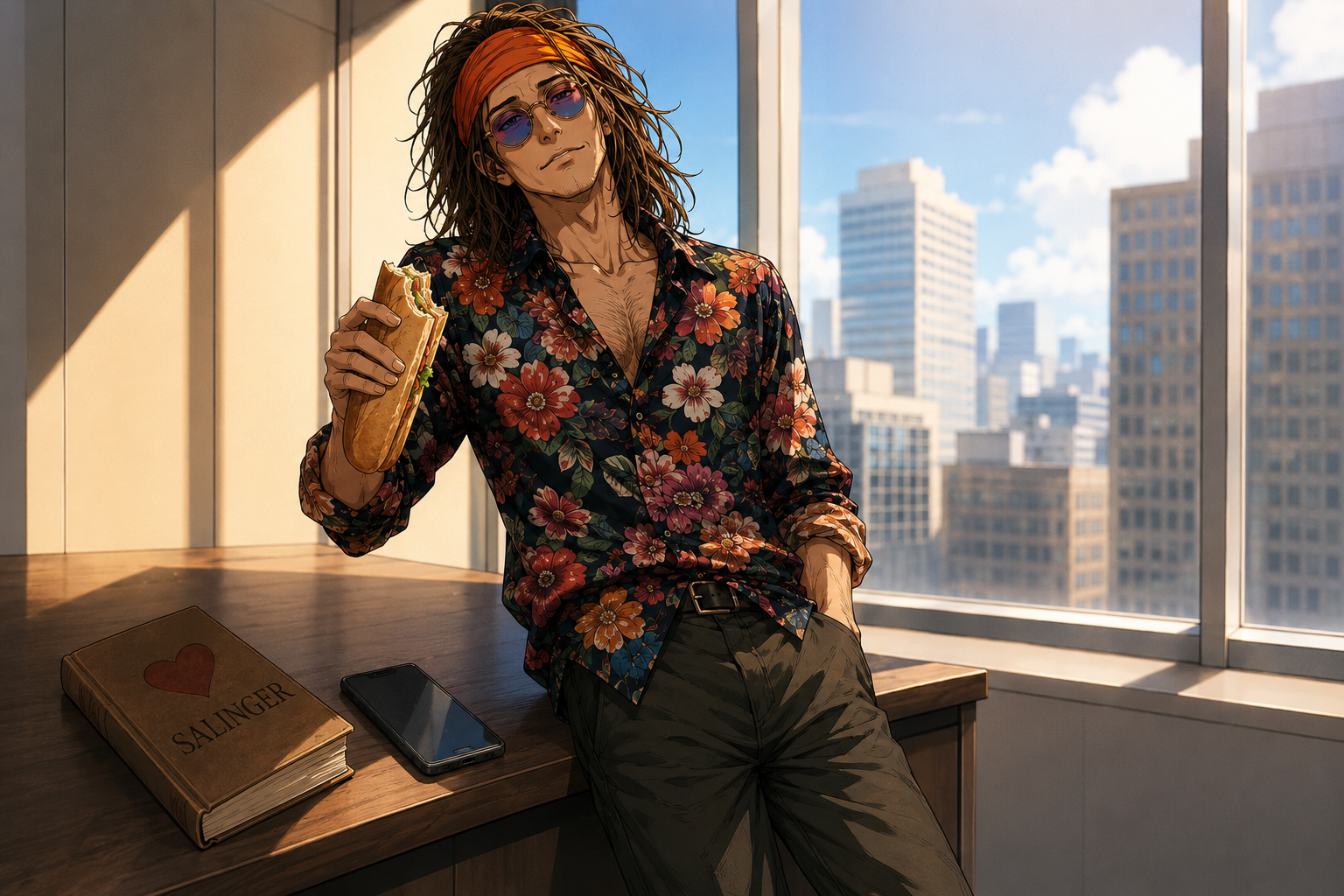
The man waiting for them, casually leaning against the edge of a table topped with Salinger's The Catcher in the Rye, looked nothing like what you'd expect from an employee of an outfit calling itself the “Obscure Organization.” His vibe was as laid-back as it got. A floral shirt, slightly tinted glasses with a strange pink-to-blue gradient and tortoiseshell temples, and long brown hair that hadn't seen shampoo in ages completed the look of someone who clearly indulged in recreational substances. At the moment, he was indulging in a sandwich while struggling to stretch a headband over hair that was clearly too big for his head.
“So, Shift, who'd you bring us?”
“This detective is going to work with us,” Finn answered.
“Cool, man. Makes a nice change from the heavy muscle and the neurotic chicks.”
The detective spoke up.
“Are you a hippie?”
“Man! Not cool! Don't call me a hippie! Can't you see I'm total beatnik??”
“Huh?”
“'Cuz see, the whole peace-and-love hippie gig? Not my jam at all, man. Dirty copycats, all of 'em. And hey, sometimes in life you gotta throw hands, y'know? Ah, don't sweat it though, man, I'm just messin' with ya...”
While listening to him ramble, the detective couldn't help noticing the Psycho twirling a knife. A cold shiver ran down his spine.
“Alright guys, what brings you here? The project all wrapped up?”
“We need support, Artist. Someone scooped us.”
“Ah, uncool... you know who?”
“Someone who knows the Organization, clearly. Or maybe even someone inside the Organization.”
“And how could you know that?” the detective ventured.
“The letter in the chest's false bottom — that was us. But the O² business card? That was already there when we arrived.”
“Impostors? Man, uncool... bad vibes, that.”
“Are you really in charge?” the detective asked suspiciously.
“Supposedly...” the beatnik replied. “But hey... I'm not the guy you should be talkin' to, dudes... you need your old man, Shift...”
“Fair point,” Finn replied. “Dad should be able to hook us up. Catch you later, Artist.”
“Yeah... keep it easy... no biggie if you blow it, nobody's gonna hold it against ya...”
As they were about to leave the room, the Artist called out to the detective one last time.
“By the way, man... chew on this... where do you think the ducks in that lagoon right near Central Park South go when it gets all frozen over?”
The detective was flabbergasted. Naturally, he assumed they'd go back through the hallway they'd come from. But stepping through the door in reverse led into a completely different corridor — it looked like the Hall of Mirrors at Versailles.
At the end, an elevator carried them downward. The detective felt a wave of vertigo when, after walking through yet another hallway, they found themselves standing on the roof of the famous commercial tower overlooking Tokyo's Shibuya district. They headed down among local pedestrians who paid them no mind whatsoever, slipping through a service door. Another corridor brought them to their destination: a solid wood door engraved with the following inscription:
OBSCURE ORGANIZATION
RESEARCH AND DEVELOPMENT
Finn knocked. And once again, total absurdity ensued.
The man who opened the door was presumably his father. Yet he looked far too young to have a son pushing twenty. But Antony recalled that the son in question had claimed to be from the future and not even born yet. Which meant they weren't talking to his father, but to his FUTURE father — a crucial distinction.
The man, a ginger dressed entirely in green, looked every bit as friendly as his future son — if not more so. Two O² logos were stitched onto his outfit, one on his cap, the other on his sweater, which looked like a...
“Why are you wearing a fast-food uniform?” the detective blurted out, caught off guard.
“Hey, I know you! You bought crepes from me!”
Faced with such a surreal interaction, the detective stood there speechless.
“Wait, that hasn't happened in your timeline yet, right?”
“No, Dad, hold on,” Finn interjected. “He's actually got partial amnesia.”
“Ah, gotcha.”
The Psycho yawned.
“So anyway, what can I do for you guys?”
“We need gear for the Jam project.”
“What's wrong with your bag?”
“Nothing, it's fine, but we've got a more pressing problem right now. We have to figure out who beat us to the punch.”
“Huh? Someone swiped the thing before you?”
“Yeah...”
“Alright, hang on, I've got just the thing.”
He rummaged through a cardboard box where the detective caught sight of the letters QW. A few minutes later, he triumphantly handed his son a security camera.
“I knew we had one left!”
“That's a security camera...” the detective observed.
“Yep. Fitted with a VCT-IM3-TR4 chip.”
“Awesome,” his son reacted. “That's exactly what we need. Can you open the portal for us?”
“Okey-dokey!”
The head of Research and Development for the Obscure Organization pressed a button, and a door swung open. The Psycho, her boyfriend, and the detective stepped through. And despite everything the detective had just experienced, he couldn't help being impressed.
Because they were back in the bar they had left at least half an hour ago. And according to the wall clock, exactly eight seconds had passed.
“Detective,” Finn began, shoving the camera into his hands, “we have a job for you. Whether you believe us or not, I assure you it'll move your investigation forward.”
“What's so special about this camera?”
“You'll see. Set it up to point directly at the safe.”
“Huh? But... but it's empty! What's the point??”
“Just do it, please. Then ask the Composer or his wife when they discovered the theft.”
“Do we really have to work with this loser?”
Ignoring the Psycho's snide remark, the detective nodded.
“How do we meet up?”
“We're playing a show at 3 p.m. at Saxo Square. Meet us there.”
It sounded clear enough to the detective, who returned to the palace, set up the camera, and questioned the Composer. That's how he learned the theft was discovered on July 7th around 6 p.m.
The Oneiric Origami concert had drawn a massive crowd, and the detective struggled to push his way through. He wondered how a duo that originally came here solely to steal an artifact from the government had managed to score such massive nationwide fame in so little time. But listening to their blistering, otherworldly riffs, he began to understand. It wasn't just music: it was the reflection of their tormented souls. And when the lead singer is a psychopath, there's at least one soul with plenty of torment to go around.
The show ran until 4:30 p.m. The detective showed up backstage, where he was ushered through.
“Well?” the trombone player asked.
“Well,” the P.I. replied, “I did what you asked.”
“The date?”
“July 7th, six o'clock in the evening.”
“Right.”
Finn casually opened his bag — the fingerprint lock that had nearly cost Éric Antony his life the day before — and pulled out a slender tube. With a click of a button, a keyboard slid out from one side, and a holographic screen projected from the other.
“Did you catch how the camera works, Detective?”
“Given everything I've seen, it seems pretty clear it films the past.”
“A bit more complex than that, but you get the idea.”
“We built it to figure out what the hell you were up to when we locked you in those bogs,” the Psycho added. She seemed to take sadistic pleasure in tormenting the detective with facts he had no way of verifying, but for his own sanity, he chose to ignore her.
Meanwhile, Finn was rewinding time on his screen. He suddenly blurted out:
“There!”
Éric Antony and the Psycho leaned over the display. The Psycho dropped the lighter she'd been holding, her jaw nearly hitting the floor.
“What... what... no way!!”
Right before their eyes, a man had just swiped the Instrument and planted the business card that had kicked off this whole mess inside the safe. The man, clad entirely in blue, wore headphones and dark sunglasses. The two musicians and the detective whispered in unison:
“The Conductor...?”
Chapter 8
Detective Éric Antony had uttered the name simultaneously with the two musicians from the Obscure Organization.
The Conductor.
Yet he had no clue what it meant. It had just slipped out. Instinct told the detective it was another trace of his forgotten past — that case that had wiped out nearly all of 2025 from his life.
The Psycho snatched up her lighter, her face twisting into pure rage.
“Who the hell does this jerk think he is? Gives us a mission and then pulls a stunt like this? I'm gonna put him down!”
Finn looked thoughtful. Everything pointed straight to the Conductor. Almost too easy. He stowed his computer and turned to the detective.
“Did you recover some of your memories, Detective? Do you know who this man is?”
“Not really... it just slipped out.”
“Ah, I see. He's the Conductor.”
“Yeah, I know, we just said that.”
“He's the head of operations for the entire Obscure Organization.”
“So he's not the Founder, am I wrong?”
“How do you know that?” Finn asked, taken aback.
Flashbacks were hitting the detective harder now. He couldn't explain how, but the facts he needed were filtering back in. The Organization's structure was coming into focus, along with faces of its staff. He recalled the man whose portrait he'd seen that very morning at headquarters: Employee of the Month. Seeing it, he'd thought the guy had a peg leg. Now, another conviction took root: that man was the Psycho's father. Again, he didn't need proof. He knew it because he'd tried to erase her birth by stopping her parents from getting married.
It was like the puzzle of his mind was solving itself. Like using an app to solve a Rubik's Cube without thinking. Like acing an exam with a pencil case crammed full of cheat sheets that no proctor ever bothered to check.
He knew. He didn't know why. He didn't know how. He was missing details, but he knew. But would this knowledge be enough to see this case through to the end — a case growing more tangled with every passing chapter?
“Something's not right,” Finn said. “It can't be Maestro.”
“I know what you're thinking,” his girlfriend shot back. “His gear, right?”
“Yeah. Why would he go back to dark shades?”
Puzzling out their remarks, the detective realized the Conductor had swapped his dark sunglasses for something else. As for what, he hadn't the foggiest. Nor did he need to dig through his memories: he'd only met the Conductor once, and that day, the head of O² was wearing nothing but shades and headphones.
“He's from a different timeline, or he's doing it to throw us off,” the Psycho concluded.
“Or maybe it really isn't him.”
“Babe, you're sweet, but not just anyone can waltz up to that safe, crack it, and leave an Organization business card inside.”
“Hey,” the detective chimed in. “What if we go confront this boss of yours?”
A heavy silence fell over them. The solution seemed obvious. But the Psycho finally spoke up.
“Do you even know where he is, Finn?”
“Uhh...”
The detective got it. In an outfit that played with the laws of physics like Danish building bricks, operating on a planetary scale multiplied by time travel and parallel realities, tracking down a walking paradox capable of being everywhere and nowhere at once was damn near impossible.
“For instance,” Finn said, “I know he had dinner with Wilhelm II in late January 1905, but that doesn't help us: neither Jamlandia nor the Instrument existed in his mind back then...”
“How could you know that?” the detective snapped.
“Well, he came from 2025...”
“If we're thinking in five dimensions, every version of the Conductor is a suspect. The one from 2025. The present-day Conductor. A Conductor from the future. For all we know, the guy who gave you this mission doesn't even know a thing about it.”
“I'm still gonna kick his ass,” the Psycho declared flatly. She grabbed her electric guitar and marched off, leaving her boyfriend and the detective staring in disbelief.
Finn turned his attention back to Éric Antony.
“There's no reasoning with her. We have to find the Conductor before she does.”
“Are you gonna use another one of those marble things?”
“The teleportation sphere? I don't have another one.”
“So you can't...”
“Get back to Organization headquarters? Of course we can. Follow me.”
Finn picked up his slide trombone and played a few notes. After everything the detective had been through over the past twenty-four hours, he couldn't even muster surprise when a vortex tore open in midair.
“Though,” Finn noted, “we'd better hurry, it only lasts eight seconds.”
“Why eight every damn time anyway?”
“Why not? Besides, this is Chapter 8.”
They stepped through the vortex, which sealed shut behind them. Éric Antony was far from amused.
“Are you pulling my leg, kid?”
“Ah, do I really have to spell out the connection between the number 8 and the infinity symbol? Good grief...”
The detective dropped it, realizing this was the most pointless conversation he'd had in a long time. They only had to walk through a door to find the man they'd met earlier, holding the exact same sandwich, with the exact same high noon sunlight streaming through the windows.
“Back so soon? Didn't you guys leave like five minutes ago?”
“More time has passed for us. We need to see the Conductor. Do you know where he is?”
The Artist sat up, his expression shifting to concern.
“Whoa, man, you know I don't mess with that when I can help it. Corporate and me, we don't exactly have a love story going on...”
“We have to see him. Right now. As project lead, you're supposed to be able to contact him.”
“Bummer, man. Guess there's no wrigglin' out of it. Alright...”
He pulled open a drawer and retrieved a smartphone. The detective noticed he didn't look comfortable holding it.
With a few quick taps, the Artist made the call.
“Ah, let me fire up that thingy... the holographic speakerphone...”
Suddenly, a man's face materialized in the room. That man, as you've figured out, was the Conductor himself. And indeed, he was no longer wearing dark sunglasses. His current glasses, built into a steampunk-inspired headset, featured one red lens and one blue lens, like retro 3D glasses. He spoke.
“Artist? What is it?”
“Yeah man, givin' you a buzz 'cuz the kid here is lookin' for you everywhere...”
“Put him on.”
“I'm here.”
“Ah, Shift, it's you. Is this regarding the Jam project?”
“The object wasn't secured.”
“What? Wait, you failed?”
“Not yet, but we used a pentadimensional camera and saw a man who looks just like you steal the object before we could, leaving a card in the Organization's name.”
“...What? How is that possible?”
“Why wouldn't it be?” the detective cut in.
“Well, Detective Antony. Working with us now, are you?”
“You and I ought to have a real talk sometime.”
“Perhaps. In the meantime, listen carefully. As a human being, I exist in a multitude of universes. But there is only one Conductor. I have no reason to assign a mission to my agents only to scoop them. It's ridiculous.”
“And what if you realized something in the future and decided to — ”
“No!” the Conductor cut him off. “No. Because I have a code of ethics. And I shouldn't have to explain it to you, because everyone in the Organization knows it. It's preposterous to think I would derail an ongoing mission of my own making.”
“What do we do?” the Shift asked.
The ceiling opened up. A platform descended. The Conductor had shown up in the flesh. He clearly deemed the situation dire enough to drop whatever he was doing.
“I'll have to intervene myself,” he concluded.
“By the way, Maestro,” his young employee added, “you might want to know that the Psycho decided to, and I quote, put you down and kick your ass.”
“Not a problem. Alright, let's go. No-Face?”
“The teleportation interface awaits you, Maestro,” replied a voice out of nowhere — a voice I've heard before, the detective thought darkly.
“You're coming with us, Artist.”
“Wh-what? Oh, man, what a hassle!”
They went through a hidden door that hadn't been there during their previous visit, emerging directly inside the vault room where the whole mess had begun.
The Conductor paced around it thoughtfully.
“No use. I need higher power. Oratrix, I order you to break the narrative and give me an answer. That is a direct command from your superior.”
Unfortunately, the ways of the Author are inscrutable. True, the Conductor possessed the ability to perceive events occurring within a six-paragraph radius of his appearances in the narrative; but even so, my humble narration would have been of no help to him.
Because the Author gave me instructions, too.
This is, technically, the third paragraph following the Conductor's last appearance in the narrative, which means he cannot foresee what happens next — or at least, shouldn't have time to react.
“Huh? What are you talking about??” he blurted into thin air, under the detective's bewildered gaze. “Wait! No, wait, not him!”
It was already too late. Heavily armed soldiers held them at gunpoint. A man stepped forward from the contingent and approached them. Éric Antony had spoken to this man several times before. And now that this figure — wearing headphones and dark sunglasses — stood face-to-face with the Conductor, the detective had live proof that his instincts were dead on.
They were clearly the exact same man.
The Composer was the Conductor.
Chapter 9
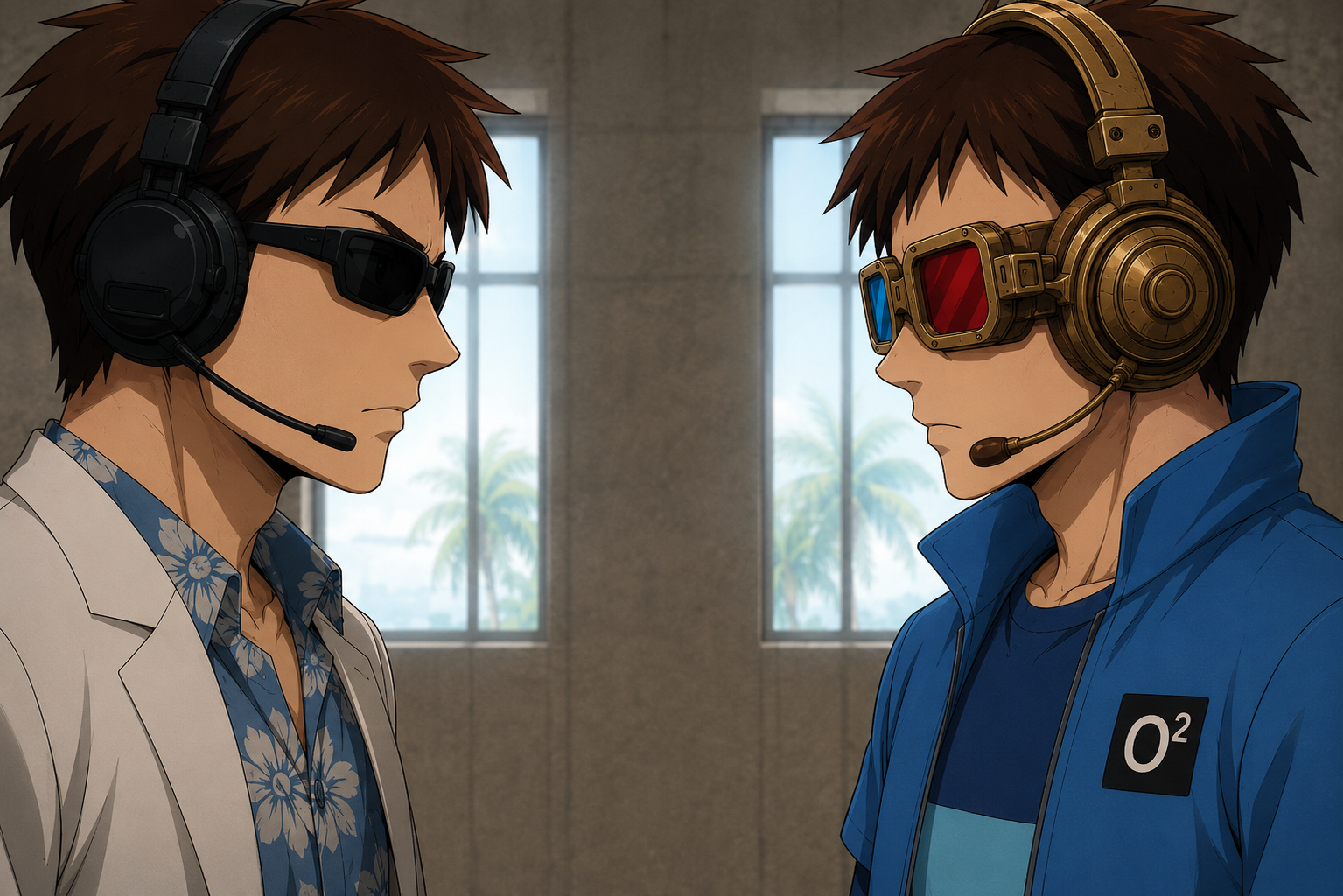
“Thank you, Éric Antony. You've brought me what I was looking for.”
“What kind of charade is this, Composer? What are you driving at? Who are you?”
“Me? Why, I am merely the humble head of state of Jamlandia. And that wouldn't have lasted much longer if this man's plan had succeeded.”
The Conductor and the Composer squared off. The leader of the Obscure Organization facing the head of state. A head of state who had used the Organization's banner to lure the detective in and, in fine, capture the leader of O² himself.
“Not cool,” the Artist muttered. “What's goin' down here?”
The Composer pulled a slender golden object from his pocket. It was the Instrument.
“Detective, we no longer require your services. We will wire your fee. You have our sincerest thanks.”
“But... you had it all along? Then why in the hell ask me to look for it??”
“Because it was the simplest way to flush out the man trying to strip me of it. Isn't that right, Conductor... or should I say Arsène Émarne?”
Nobody in the room was particularly shocked by this bombshell, mostly because not a single soul present recognized the name. The Conductor looked down his nose at his counterpart and shot back:
“Well played, Arsène Émarne.”
The Artist slumped to the floor, crossed his legs, and remarked:
“Okay, now you've completely lost me, man.”
He reached into his jacket for something, but the Composer cut him off.
“We are, after all, in a presidential palace. I must ask you to refrain.”
“Maaan... uncool...” the Artist replied, pocketing his joint.
“So there really were two Conductors?” Finn asked.
“I assure you there is only one Conductor,” the man replied, “and I am in a position to know. This man and I are two sides of the same die. He is not me in the future. He is not me in the past. He is me in another world, simple as that.”
“But how could he possibly know about you?” the detective asked, thoroughly bewildered.
“I have a pretty good idea,” the Conductor replied. “He did just like Érasme Ennare before him, that's all...”
“Érasme Ennare?” the detective repeated. Something felt off. Then it hit him. The phonetic match was too uncanny to be coincidence. “Wait... that's an anagram! YOU are the painter??”
“Not me. Another me. Another me who tapped into the morphogenetic field.”
That explanation might have satisfied anyone who had lived through a quarter of the wild adventures you've just read. But Éric Antony remained skeptical.
“No, hold on. If nobody lied, he was a nineteenth-century painter. How on earth could — ”
“My, how obtuse you are, Detective. Please learn that every Arsène Émarne was born in 1822.”
That was perhaps the biggest shock yet for the detective. That the Conductor — leader of an outfit capable of warping the very laws of space and time — originated in the nineteenth century? Sure, why not. But if so, how was someone from that same era standing here in 2026, in the prime of his life, running a microstate? The latter finally spoke up.
“You and I walked the same path, Conductor. We attempted and achieved the impossible. But our trajectories diverged. While you became the leader of this unbelievable organization, I merely became a head of state. But like our painter counterpart, as you guessed, I tapped into the morphogenetic field. I saw myself, not just running a nation, but at the helm of an inexplicable syndicate. I saw the O² logo in my mind's eye. And I knew. I knew that another me, somewhere out there, had accomplished far more than becoming a head of state.”
“If you're anything like me,” his counterpart shot back, “you ought to hate monologues.”
“Touché. Regardless, there's no need to say much more. With the exception of the detective, you are all under arrest.”
“Is that so?” The Conductor smirked. “You think you can lock up representatives of the Obscure Organization? Ha! That's a good one. Do you realize our very syndicate controls the narrative? Oratrix!”
Unlike the previous attempt, this summon to the narrative met with a response. For a high-strung young girl had joined me a few minutes earlier. I swung open the narrative's door, and she charged right in, armed with her electric guitar.
With a predatory grin, the Psycho dropped into the middle of the room and struck a jarring chord. The sonic dissonance neatly shattered the soldiers' weapons. The Artist, back on his feet, suddenly stepped right up to the Composer, utterly obliterating any sense of personal space, making the head of state flinch back. But the Artist merely snatched the Instrument from his grip with unexpected force. It was at that moment the detective realized what kind of instrument it was: a kazoo.
The Artist tapped two fingers to his temple in a casual salute, punctuated by:
“So, yeah... mission accomplished after all, man...”
Finn was next to act. He pulled something from his bag, threw it to the ground, and set off a thick cloud of smoke.
The detective and the Composer started coughing. The soldiers, equipped with gas masks, didn't have to worry about it.
When the detective regained his sight, every member of the Obscure Organization had vanished. The Composer, furious, spun on his heel and left the room, flanked by his troops. Left alone, the detective pondered the situation.
He stayed in the room for a while, taking advantage of the sudden silence to gather his thoughts. Hired to recover an object seemingly stolen by O², he had ultimately witnessed the object's theft after the fact. He had walked straight into a trap. In fact, he was becoming increasingly convinced that the missing painting was still in the palace, unlike the Instrument. Out of curiosity, he pulled out his phone and pulled up the website for Oneiric Origami's exhibition, The Possibles. He examined the painting 'Before the Show'. Zooming in on the image, sure enough, there was a kazoo — looking wildly out of place — painted right onto the canvas.
Deep in thought, he failed to hear approaching footsteps.
“Detective...”
He looked up. Melody Oxid, the head of state's wife, had joined him.
“I am so sorry. We had no other choice. And now, my husband's own actions are going to trigger his removal from office...”
The detective gave her a grave look. Her face was stained with tears. It isn't easy being a character in a story where nothing is black and white.
“Something is bound to happen,” Éric Antony finally said. “They won't just stop there, I don't buy it for a second. Look, your husband didn't play straight with me. But the job you gave me still stands. I'll find the Instrument and get to the bottom of this.”
“Thank you, Detective.”
Right then, his eye caught a purple glow emitting from the floor. A glow he had seen and used before.
“A teleportation sphere...” he whispered.
Chapter 10
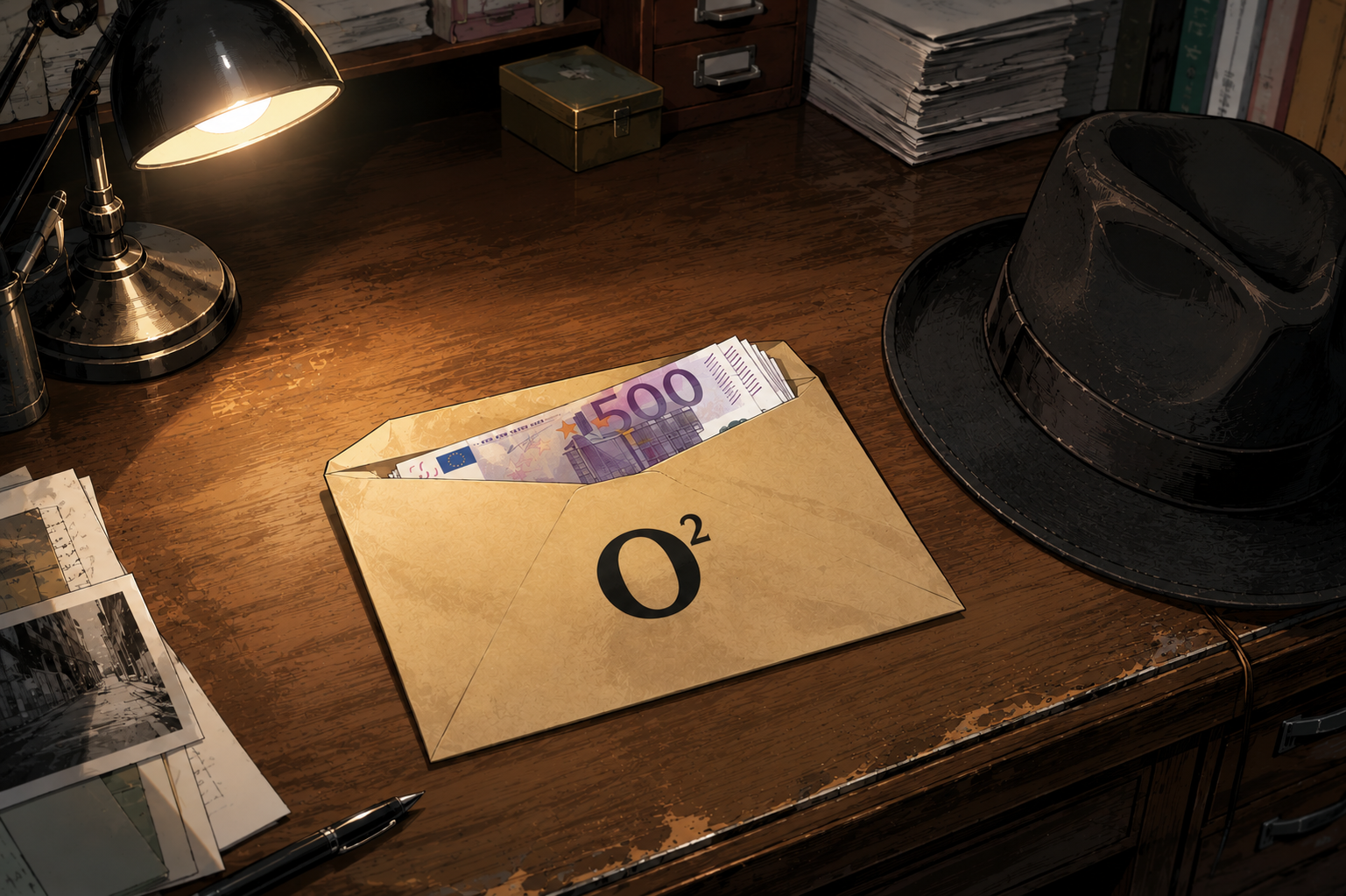
When the detective opened his eyes, he surveyed his surroundings, taking it all in.
He had stepped onto the teleportation sphere and, just like before, activated it with a blink.
First off, he noticed broad daylight. Morning. Either he had traveled through time, or he was in a different time zone altogether. Next, he realized he was standing on a terrace overlooking a beach.
Then he turned around.
And his heart stopped cold.
“MATTHIAS!”
His assistant was right there, lying face down on the ground in a small pool of blood.
“MATTHIAS! Come on, buddy, wake up!”
The detective carefully turned him over. Searching his body, he found the wound. It wasn't superficial. He wasn't going to die immediately, but he needed emergency medical attention.
There are two possibilities, the detective reasoned. Either I'm in Santa Monica, or they dragged Matthias along with them.
But Matthias was in no state to answer.
“Detective...”
He spun around. It was Finn.
“Did you do this??”
“Technically, I'm capable of it. But no, it wasn't me. Still, I was tasked with delivering a message to you. Because naturally, we knew you'd follow.”
“Tell me later! Who hurt Matthias??”
“He was around back in 2025 too, though I don't think you bumped into him — well, given what you knew back then, if your memory were intact, you'd know who I'm talking about. It was the One-Eyed. But that won't do you much good. As a transdimensional entity, the Organization guarantees its operatives technical immunity from any court of law...”
A woman appeared. Clad in red, she had long black hair and inexplicably purple eyes. She smiled — the practiced smirk of someone who knows how to project pure malice with a single glance.
“Welcome to the party, Detective. Don't mind me, though — I played lead in previous stories, I'm just a humble extra here.”
“What do you want?”
“Honestly? I'm here to fix up your assistant.”
Under Antony's dubious gaze, she knelt over Matthias's motionless body.
“Hey, Shift! Hand me what I need to patch him up!”
“Right away, Wild Card!”
Finn pulled several vials and bandages from his bag.
“Yeah, he's bleeding like a stuck pig,” the young woman observed with chilling detachment. She stripped off his t-shirt, applied medicine, and bandaged the wound. Then she pulled out a strange stone emitting a green aura.
“What on earth is that??” the detective asked.
“A fairy stone,” the Wild Card explained, placing it over the wound. “It works like a sponge. Left at Tara, the most magical place in the world, in a Reality where fairies exist, it literally soaked up their magic. Not quite as good as a real fairy, but you ought to thank me — he'll be back on his feet in no time.”
She stood up and tossed a bottle of pills to the detective.
“He's got a fever. Give him one of these when he wakes up. I'm taking his t-shirt — it's ruined.”
Without further ado, she walked off. Finn was already holding out another t-shirt to the detective.
“Alright,” Antony said after redressing his assistant. “You've got some explaining to do. Assuming your motive for taking the Instrument is legit, why now?”
“What do you mean?”
“Why did you have to do it right now? Why not at a time when the Composer isn't the same person?”
“What difference does it make? In any case, a man has to be stripped of his lifelong status as head of state.”
“So why now?”
“Ah, pushing the point, are we, Detective? Beats me. The Conductor makes the calls around here.”
“But... surely he must have known who the Composer was, right?? And what about that message you were supposed to give me?”
“Er... I don't have to do it anymore...” Finn replied, taking a step back.
“Detective. There you are. You took your sweet time joining us. You wanted to talk, if I recall?”
The Conductor had just made his entrance. In his hands he held a golden kazoo: the Instrument symbolizing the power of Jamlandia's head of state. The detective, despite having so many questions, almost lost his composure. But the leader of O² pressed on.
“Rest assured my organization sympathizes with your plight, Detective. But what can you do... without an adversary standing in our way, there would be no story...”
The detective, having long since realized the story he was living followed no traditional rules, had a wave of flashbacks.
“To you, I'm just a convenient foil, isn't that right? Someone you can pull like a puppet? Lock in public restrooms? Blow up a toy tape recorder right in his face? Prematurely age by twenty years??”
“Ah, here we go. The Organization answering for deeds that ought to have been wiped from your memory. As for the premature aging, you brought that on yourself, Detective, and the author did you a favor by erasing all events of 2025 from your life, de-aging you in the process. Perhaps he didn't foresee your flashes of memory returning, but well... I suppose you, too, have the ability to access the morphogenetic field.”
“What do you mean?”
“Detective. The events of 2025 did happen, in every sense. But this story is a different matter entirely. You're clinging to memories that don't really belong to you anymore. Your town and your business were shifted to another Reality by the author's very pen, do you understand? You aren't an anomaly. But your memories are.”
“What? What?? What right does the author have to strip me of my memories??”
“Right? The author doesn't have the right, Detective? Ha! Come now! You are a fictional character, and you know it full well! You ought to be grateful! Yes, grateful that the person pulling all the strings likes you enough to grant you another novel!”
The detective glanced at Matthias. His assistant's breathing had evened out, bringing a wave of relief.
Turning back to the Conductor, he said:
“Is that all you have to say?”
“I loathe monologues. If you have a question, ask it.”
“Fine. Explain your grand plan with Jamlandia's government Instrument. Why did you need to recover it right now? Why is an alternate version of you from the nineteenth century running a state, and how on earth could that alternate version anticipate — even granting the morphogenetic field — that you were coming to strip him of the Instrument?”
“Ha. Pertinent questions. You really want to force a monologue out of me, don't you?”
“Answer me!”
“Nothing forces my hand. But I shall satisfy your curiosity and that of the readers anyway. Catch this first.”
The Conductor tossed a folder to the detective, who read the title:
“Treatise on the existence of five dimensions; and on the consequences that would result from their full exploitation by mankind”
The text looked old, but a note had been added directly onto the cover page in ballpoint pen:
“Written in Paris between 1840 and 1842 by an auditor not enrolled in the courses of the Faculty of Sciences of Paris, this treatise was never officially presented. We present it here without its appendices, which have not been found.”
“A not enrolled auditor... Could it be...”
“Read the document. Without the appendixes, it's fairly brief.”
The treatise indeed spanned only five pages, but it laid out the core theories Finn had explained to the detective earlier: Time and Reality as the fourth and fifth dimensions, and fiction as the generator of Reality. Reality generating fiction, which stemmed from that principle, was not mentioned, however.
Reaching the end of the document, the detective confirmed his instincts were correct. The author intended to become the guinea pig of his own spatio-dimensional displacement experiment, utilizing a machine named after himself: the Émarne spatio-dimensional displacer.
The Conductor spoke up again:
“So, Detective, do you get it now?”
“You're... you're...”
“The pioneer of five-dimensional travel. And I am not alone. In numerous Realities, other versions of Arsène Émarne attempted the experiment. Some died. Others failed. And then there's this curious case that will make your skin crawl: I am my own ancestor, Detective.”
“Huh??”
“One of my counterparts wound up in the seventeenth century and married my great-grandmother.”
“And the painters?”
“Their trajectory never led them to conceptualize anything. They mostly painted visions of what other Émarnes experienced. I believe that answers your question about the head of state, doesn't it? That Arsène Émarne landed in the twenty-first century, and sheer chance brought him to office. Tapping into the morphogenetic field, the Émarne painters had a vision of this story and painted 'Before the Show'.”
“And what about you?”
“My own trajectory is far more complex and isn't the subject of this story at all. As for how the Composer anticipated my arrival, I don't think you've quite grasped that the morphogenetic field transcends all dimensions. It's an invisible field present simultaneously across all of existence. You already know that Arsène Émarne, as an individual, has a knack for tapping into it easily. The Composer learned of my plan by accessing it — there's really nothing more to it.”
The puzzle pieces were falling into place — at least the ones the Conductor chose to reveal. The detective pushed back.
“That still doesn't tell me why you needed the Instrument right NOW.”
“Do you know, Detective, who else accesses the morphogenetic field?”
The blunt question left the detective speechless. So his companion continued.
“Two authors. The author of this story, and the author of the video game Tomo Jam. It's from that convergence that this Reality was born. If we had to act now, it's because later would have been precisely too late.”
“...Excuse me?”
“Tomo Jam is still a game in development. It's a perfect breeding ground to embed the Organization. Because, Detective, our syndicate aspires to infiltrate everywhere. Given how your memories come back in fits and starts, I doubt you'll question my word if I tell you the Organization, by sheer force of will, influenced the choice of a social network's mascot...”
The detective said nothing. He couldn't deny it. It was the honest truth. When the Organization had infiltrated the social network Qwice, it resulted in the creation of the Qwokka.
Having stayed silent all this time, Finn spoke up:
“I think the detective got his answer, didn't he? Should I show him out?”
“Not so fast!” Antony snapped. “I still have questions!”
The Conductor let out a long sigh. He snapped his fingers, and something truly astonishing occurred: space warped. The terrace shrank. Walls shot up, along with a desk, a bookshelf, and armchairs. The detective stared at his companion in disbelief.
“But... how... how did you...??”
“Did you think we were in the real world? We are neither in Jamlandia nor in Santa Monica, Detective. We are inside Organization headquarters. In this domain, I act as the author's proxy. Which means I have total freedom to alter space. It seems this conversation will take a while, so have a seat. Coffee?”
The detective noticed a cup of coffee was already waiting for him. Giving in to the Conductor's invitation, he sat down.
“Splendid. Let us continue our chat. What else do you wish to know?” the leader of the Obscure Organization asked, taking his seat opposite Éric Antony.
“What's the truth about this kazoo? I'm certain I haven't been told everything, or I've been lied to!”
“Actually,” the Conductor pondered, “I must confess I manipulated my own agents by withholding information. But you're used to that by now, aren't you, Shift?”
Finn didn't answer.
“To guarantee the Organization's presence in Tomo Jam, which is a rhythm game, after duplicating the Instrument to send it into the past, we're putting it back into circulation. It will be the grand prize in a major contest. The winner takes the Instrument. Naturally, our musical duo will participate. And I expect Melody, the Composer's lovely wife, will try her luck as well. You see? We play fair. And it only took ten chapters to reach this conclusion. Detective, your investigation has come to an end. We have no further need for you. Shift!”
The young trombone player suddenly slammed a chloroform-soaked rag over the detective's nose, knocking him out cold.
When he woke up, he was back in his office at Promenade-les-Pins. In the background, he heard a trumpet playing — a sure sign that Matthias had recovered.
On his desk sat an envelope stamped with the O² logo. He opened it: inside was a thick wad of cash.
That was the end of the detective's investigation. He had no idea what lay ahead for Jamlandia. The Organization, however, seemed to know. And in any case, the question would not go unanswered, for all of this was merely a prelude to the next act of the Obscure Organization's misdeeds...
JAM WITH O²!